
A sweeping reset of federal nutrition policy aims to put real food at the center of the American diet, with a blunt call to cut back on highly processed foods and added sugars.
Released January 7, the Dietary Guidelines for Americans, 2025–2030, marks a significant departure from past recommendations, redefining expectations for how Americans eat and creating new challenges and opportunities for farmers, manufacturers, and retailers.
Although the guidelines are reviewed every five years, they have been largely stable since 1980. The new framework is a cornerstone of the Trump administration’s “Make America Healthy Again” agenda under Health Secretary Robert F. Kennedy Jr., and it signals a policy tilt toward nutrient-dense, minimally-processed foods.
Kennedy and US Department of Agriculture Secretary Brooke Rollins said federal incentives have favored “low-quality, highly processed foods,” calling the typical American diet a “crisis” driven by poor policy, inadequate research, and a lack of coordination across federal, state, local, and private partners.
“This changes today,” Kennedy and Rollins said. “We are realigning our food system to support American farmers, ranchers, and companies who grow and produce real food — and the Trump administration is working to ensure all families can afford it.
“We are putting real food back at the center of the American diet. Real food that nourishes the body. Real food that restores health.”
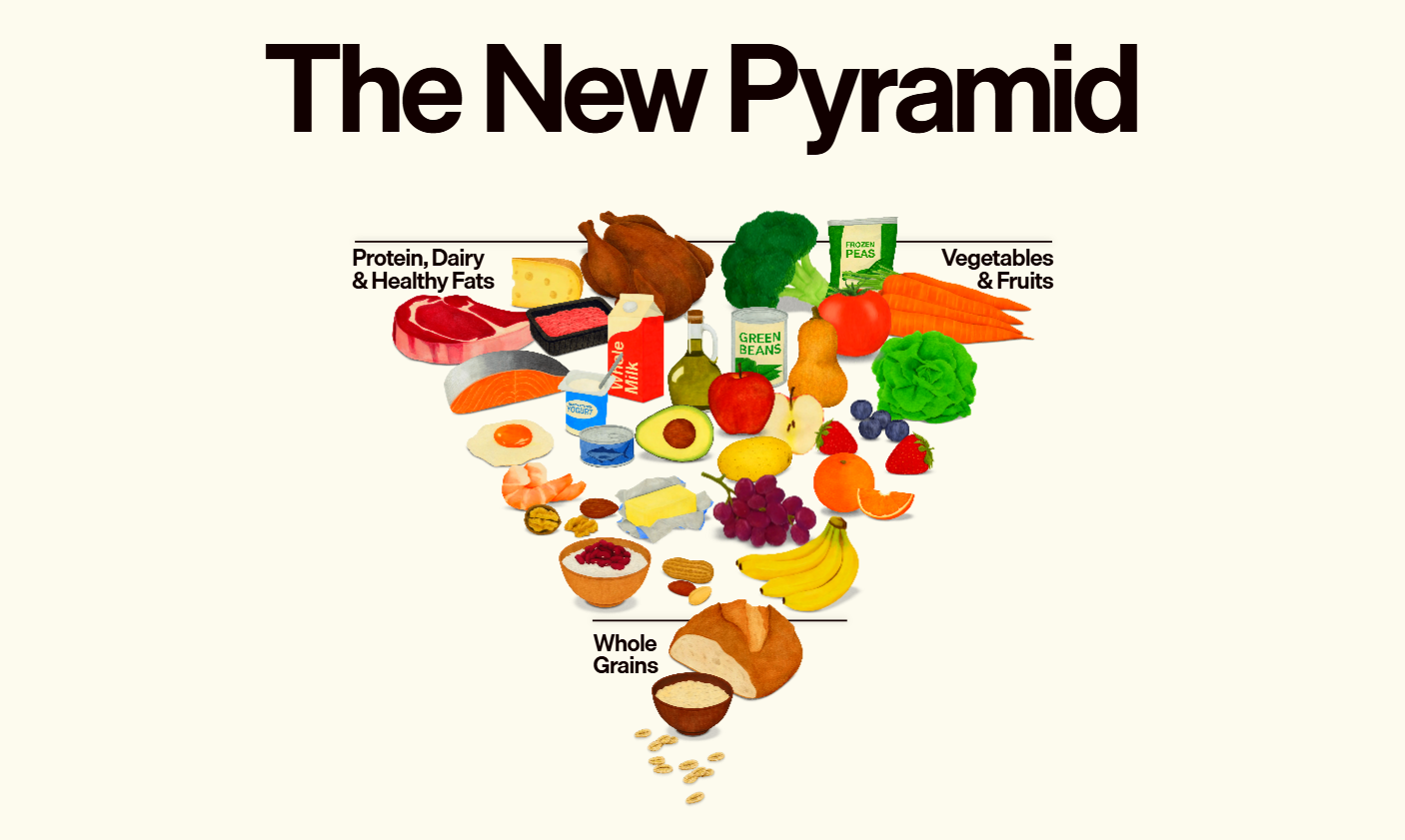
The report’s simple directive, “eat real food,” is backed by a framework of nutrient-dense building blocks: Protein, dairy, vegetables, fruits, healthy fats, and whole grains.
Below are the implications for key commodity categories and for special populations.
Dairy
The updated dietary guidelines elevate dairy products such as whole milk and cheese toward the top of the food pyramid, highlighting the benefits of the healthy fats found in full-fat options.
Consumers are encouraged to choose full-fat dairy without added sugars and aim for about three servings per day within a 2,000-calorie diet, adjusting as needed based on individual needs.
US sugar consumption has declined steadily over the past five years, driven by changing diets and the growing use of GLP-1 drugs, according to Expana’s Andraia Torsiello and Brittany Feyh (customer access only.)
The shift has weighed on sugar prices while boosting demand for whey protein, which has outstripped domestic production and created a supply-demand imbalance in the US.
The latest dietary guidelines could further support demand for dairy products, including whey, while reinforcing cutbacks in added sugars and processed foods, potentially shaping market dynamics for both sectors.
In related news, the US House of Representatives approved the Whole Milk for Healthy Kids Act of 2025 last month, clearing the final congressional hurdle for legislation that would return whole and 2% milk to school cafeterias nationwide for the first time in over 10 years.
The measure is expected to be signed into law by US President Trump.
Under the bill, schools must offer students a range of fluid milk choices, including flavored and unflavored organic or conventional whole, 2%, 1%, skim, and lactose-free milk.
The legislation removes milk fat from schools’ per-meal saturated fat limits, making it easier for nutrition directors to include whole and 2% milk in menus.
Vegetables and Fruits
Right alongside the proteins, the new food pyramid prioritizes a colorful diet with two fruit servings per day and three vegetable servings per day (whole foods) rather than highly processed foods.
So, the new guidelines differentiate between eating potatoes versus a processed snack food made from potatoes, like chips or french fries. Still, producing companies are addressing changes in consumer habits by rebranding and reformulating their snack products. For example, Lay’s will relaunch with new packaging reading “made with real potatoes”, wrote Expana’s team (customer access only.)
Interestingly, the guideline does not address organic vegetables and fruits versus non-organic. However, the new report advises Americans to wash vegetables and fruits thoroughly before eating raw or cooking, without providing specific guidance on how to wash.
The new dietary guideline also addresses gut health–something a well-balanced diet supports.
“Your gut contains trillions of bacteria and other microorganisms called the microbiome. A healthy diet supports a well-balanced microbiome and healthy digestion. Highly processed foods can disrupt this balance, while vegetables, fruits, fermented foods (e.g., sauerkraut, kimchi, kefir, miso), and high-fiber foods support a diverse microbiome, which may be beneficial for health,” reads the diet guide.
Specific to juices, 100% fruit or vegetable juice should be consumed in limited portions, or diluted with water, according to the guide.
Overall, US farmers were being considered in the making of the US Dietary Guidelines, according to Rollins (customer access only.)
“As we begin to move the market toward more locally produced, American made, healthier products closer to the schools, the hospitals, etc… You open the market to the great products produced by farmers instead of ultra-processed foods out of a box,” said Rollins.
Protein
According to the update, Americans are encouraged to include protein foods at every meal, focusing on high-quality, nutrient-dense sources. The serving goals outlined in this report are 1.2 – 1.6 grams (approximately 0.042-0.056 ounces) of protein per kilogram of body weight per day.
“Pretty interesting shift toward protein overall. Under the previous 0.8 g/kg guidelines, intake would have been roughly 69 g/day, while the updated guidance implies about a +34 to +69 g/day increase to 103–138 g/day for someone my weight (190 lb body weight or ~86.2 kg),” said Mason Augustino, an Expana Pork Market Reporter.
Previous guidelines from 2020-2025 recommended roughly 3.7 ounces in total per day (or ~105 grams).
The recommendations cover animal sources, including eggs, poultry, seafood, and red meat, as well as a variety of plant-sourced proteins, such as beans, peas, lentils, legumes, nuts, seeds, and soy products.
Additionally, the guidelines advise against deep-frying, suggesting healthier cooking methods such as baking, broiling, roasting, stir-frying, and grilling.
Healthy Fats
The new guidelines also suggest incorporating more healthy fats into diets. These fats are defined as unsaturated fats found in plant oils, avocados, nuts, seeds, and fatty fish, including salmon, mackerel, sardines, anchovies, and tuna, to name a few.
For cooking and adding fats, choose oils that provide essential fatty acids, such as olive oil. Butter and beef tallow are also considered good alternatives.
“More high-quality research is needed to determine which types of dietary fats best support long-term health,” reads the new guide.
The consumption of saturated fat should not exceed 10% of total daily calories, unchanged from the previous report. Additionally, the guidelines emphasize that limiting highly processed foods can help in achieving this goal.
Sugar & Sweeteners
As a whole, the new dietary guidelines tell Americans to stop snacking. Caught in that crossfire are sugars and other sweeteners like high fructose corn syrup often added to candy, cookies, beverages, and more.
Plus, the guidelines rule that “no amount” of added sugars or sweeteners are recommended. However, the writers do qualify that meals should not contain more than 10 grams of added sugars.
“When selecting snack foods, added sugar limits should follow FDA ‘Healthy’ claim limits. For example, grain snacks (e.g., crackers) should not exceed 5 grams of added sugar per ¾ ounce whole-grain equivalent, and dairy snacks (e.g., yogurt) should not exceed 2.5 grams of added sugar per ⅔ cup equivalent.”
Officials writing the guidelines also gave consumers tips about how to read ingredient labels–specifically to identify added sugars.
“To help identify sources of added sugars, look for ingredients that include the word ‘sugar’ or ‘syrup’ or end in ‘-ose.”
The report also alluded to foods with naturally occurring sugars to separate sugar consumed though fruits, and that consumed via snack foods.
Product reformulations and evolving sentiment about ultra-processed foods and beverages is something that the Kennedy-led Make America Healthy Again (MAHA) movement has long awaited. Plus, the US Health Secretary has been quoted as saying that “sugar is poison,” reported Expana (customer access only.)
Having said that, there is some consumer perception held about cane sugar, for example, being a more natural sweetener, than that of high-fructose corn syrup—not to mention the consumers who go out of their way to look for Coke made with cane sugar (customer access only.) due to taste preferences. Despite these feelings, the new USDA guidelines do not differentiate between sources of sugar like corn syrup, honey, or cane sugar.
Other product reformulations have come in the form of food dye and artificial ingredient removals, subbing seed oils for beef tallow, and more from the White House.
Alcoholic Beverages
In short, the new guidelines aren’t capping consumption of wine, beer, liquor, or even Buzzballs for that matter–nor are the officials touting any positives to drinking.
Instead, the USDA writers are just saying: “Consume less alcohol for better overall health.”
The recommendation differs from the previous recommended limit of one to two drinks per day.
Having said that, the guidelines do address “at risk” individuals who might consider avoiding alcohol consumption altogether.
Overall, alcoholic beverage market participants should be pleased with alcohol’s short section in these dietary guidelines–which seems open to interpretation. In 2025, after the industry reached a high point around COVID, the alcoholic beverage market has softened due to cash-strapped consumers that have become more health-conscious and who have been choosing drinking occasions more carefully as other options (like legal cannabis) have hindered consumption.
Special Populations
The Dietary Guidelines emphasize tailored nutrition across life stages. For infants, exclusive breastfeeding is recommended for about six months, with the introduction of a variety of nutrient-dense solids around six months and avoidance of added sugars. Young children should focus on whole foods, including full-fat dairy, to support brain development. Adolescents need increased protein, calcium, and iron, while limiting sugary and processed foods.
Pregnant and lactating women require higher intakes of key nutrients such as iron, folate, iodine, and omega-3 fatty acids, and prenatal vitamins are advised. Older adults should prioritize nutrient-dense foods to meet protein and vitamin needs, despite lower calorie requirements, often supplemented with medications.
Individuals with chronic diseases may benefit from diets lower in carbohydrates, while vegetarians and vegans are advised to monitor potential nutrient gaps and consider supplementation to maintain balanced nutrition.
Co-authored by:
Courtney Shum
Expana
1-732-240-5330
[email protected]
Natasha Estremera
Expana
1-732-240-5330
[email protected]
Ryan Gallagher
Expana
1-732-240-5330
[email protected]
Image source: USDA
Written by Ryan Doyle