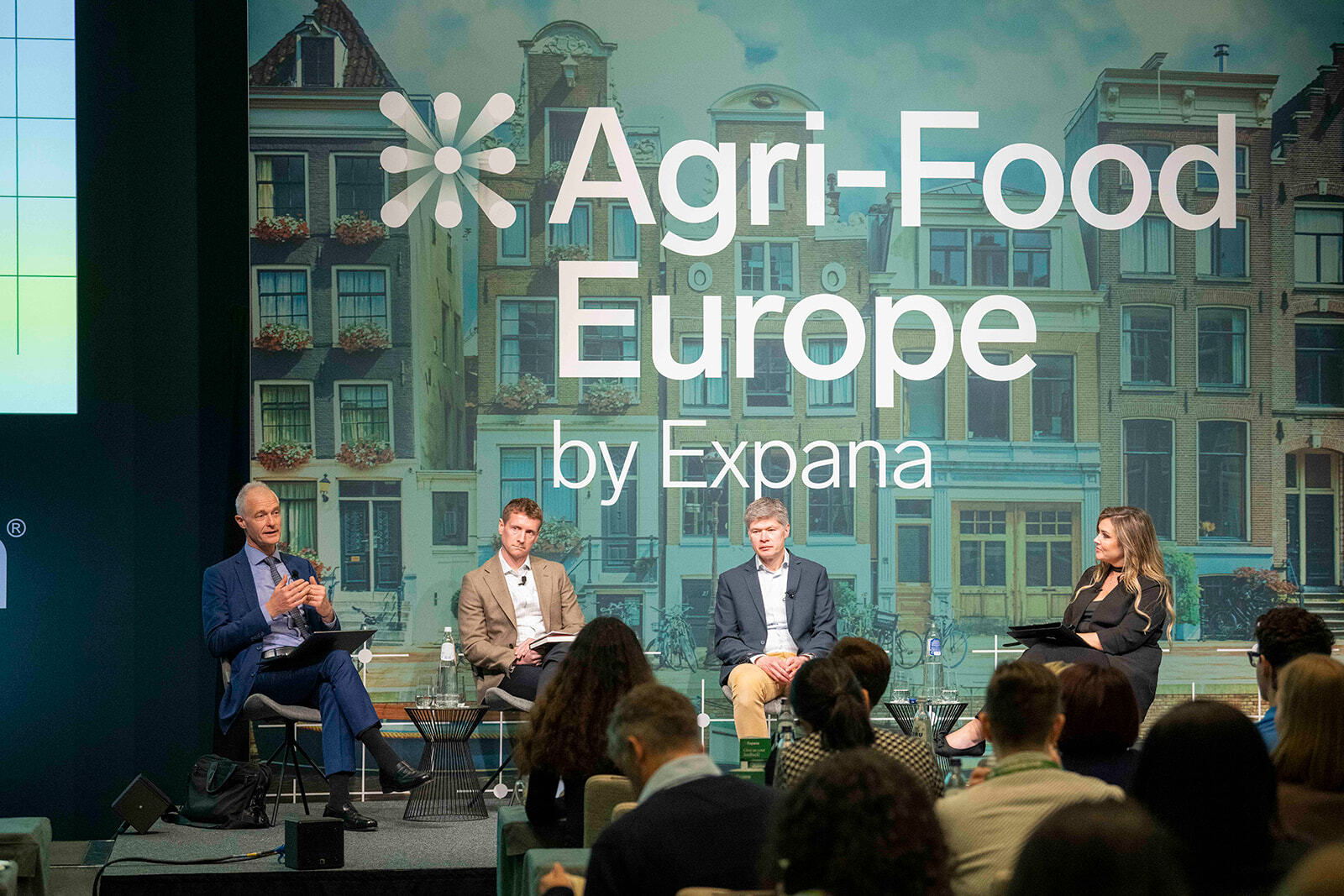
Geopolitical tensions, volatile tariff regimes and shifting trade policies are forcing companies to reassess how they manage risk in global commodity markets, speakers said at Expana’s Agri-Food Europe event in Amsterdam.
The panel, “Building Resilience in a Geopolitically Unstable Marketplace,” featured Cédric Pène, Counsellor at the World Trade Organization; Matthias Bauer, Director at the European Centre for International Political Economy; and Frans-Paul van der Putten, Senior Research Associate at the Clingendael Institute.
Pène said commodity markets have experienced repeated shocks in recent years, beginning with the COVID-19 pandemic. “The big issue was food security,” he said. “The food system has proven to be secure. The system succeeded in adjusting.”
The major sources of instability
He said tariffs have since emerged as a major source of instability, citing sharp fluctuations in US duties on agricultural products since early 2025. “Super volatile tariffs,” Pène said, referring to rapid increases and reductions that disrupted market planning.
He added that these developments have encouraged European countries to strengthen trade relationships with alternative partners, although most global trade remains governed by WTO rules. He also pointed to demographic pressures, including aging and shrinking populations in some countries, as an additional structural challenge. “Globalization is better connecting the world, leading to more efficiency, but it can also lead to vulnerability,” he said.
A new phase
Bauer said the global trading system has entered a new phase, particularly in relation to tariffs and regulatory barriers. “We are in an entirely new situation when it comes to tariffs,” he said. “But when it comes to trade barriers, those matter more than tariffs.”
Despite geopolitical tensions, he said trade volumes remain strong. “Trade is not collapsing. We still see record levels of trade,” Bauer said. “I take this as hard proof that globalization is ongoing.” What has changed, he argued, is how governments manage trade. “It’s not the volume of trade, but the political management of trade,” he said, pointing to a growing tendency for states to act as market participants rather than rule-setters.
He warned that diverging regulatory frameworks are creating uncertainty for companies. “The more important question is whether the system remains rules-based and predictable, or becomes politically driven,” Bauer said.
Van der Putten focused on relations between the United States and China, saying geopolitical pressure has reached practical limits. “The US government tried to see how far it could push China and then found out it couldn’t push as hard as it wanted,” he said.
He said China’s response, including restrictions on exports of critical materials, showed that both sides are reassessing their relationship. “I think we’ve reached more or less a truce,” van der Putten said. “Both sides are figuring out how they can maintain a relationship.”
He added that this shift could lead the United States to redirect pressure toward other regions, leaving Europe in a weaker position. “The nature of our relationship with the US is changing,” he said.
The increasing importance of location
Van der Putten also said that corporate nationality and supply chain location have become increasingly important. “Where companies are based and who their supply chain partners are used to matter very little,” he said. “Now it is significant and will probably continue to matter.” Bauer said many firms are responding to geopolitical risk by diversifying suppliers and increasing contractual flexibility, but often without addressing underlying policy drivers. He added that Europe is gradually moving toward greater strategic autonomy, with governments playing a more active role in economic policy.
From a regulatory perspective, Pène said the WTO remains central to managing global trade tensions. “For the system to work well, we need well-informed governments and clear communication,” he said. “Our stance is: help us help you.”
Van der Putten said developments in sectors such as energy and semiconductors show how supply chains are increasingly being used as tools of political influence. “The weaponization of supply chains and economic dependency is increasing,” he said, warning that politicization in one sector could spill into others. “States will always look for ways to protect their food sectors.” He added that while the WTO remains essential, some policymakers, particularly in the United States, have questioned its long-term role and discussed alternative governance structures.
What is next?
Looking ahead, Bauer said geopolitical flashpoints, including tensions over Taiwan, could trigger further market shocks affecting energy, fertilizers and shipping routes. “Those shocks would spread quickly,” he said.
Despite the risks, he expressed cautious optimism. “We might see a change in tone,” Bauer said. “We might see something better than the WTO.”
Van der Putten said China’s growing technological capacity and influence in emerging markets will continue to reshape global trade, while Europe may face pressure to reduce economic ties. “For Europeans, there is a risk of forced political detachment from China,” he said, extending beyond trade to technology and investment.
Panellists agreed that while global trade volumes remain resilient, the political environment surrounding trade has become more contested and unpredictable, requiring companies to place greater emphasis on diversification, flexibility and geopolitical awareness.
As geopolitical competition intensifies, speakers said resilience will depend less on efficiency alone and more on how well firms understand and adapt to an increasingly politicized trading environment.
Written by Fei Thompson