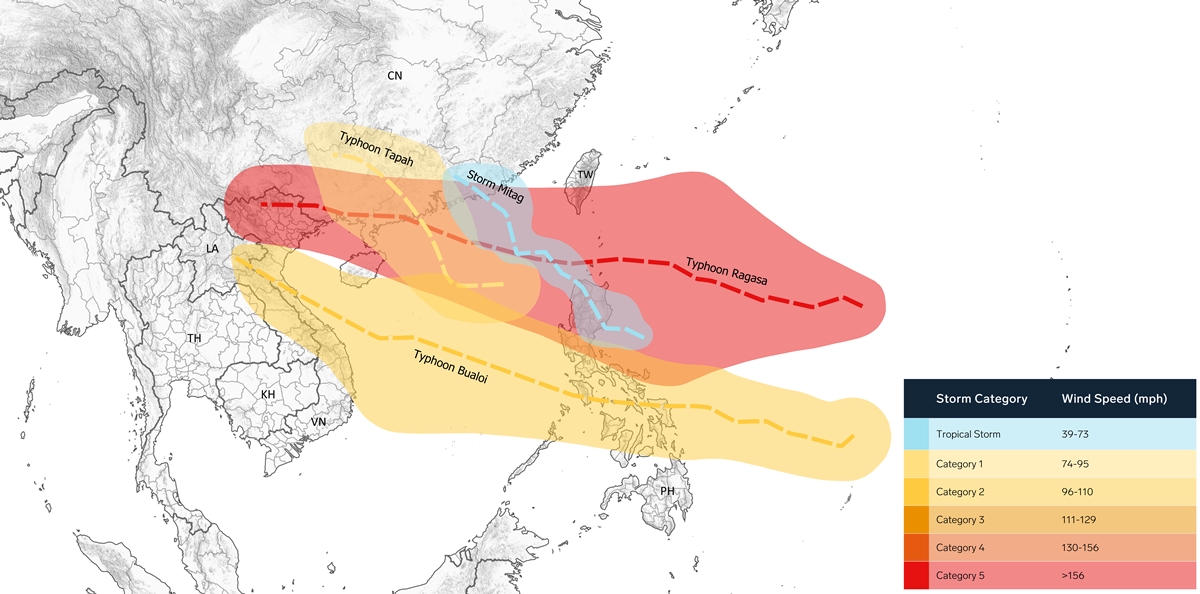
Four storms — Typhoons Ragasa (Nando) and Bualoi (Opong) and Tropical Storm Mitag (Mirasol) in the Philippine Sea, and Typhoon Tapah (Lannie) in the South China Sea — swept through the region in September, damaging rice, corn, coconut, and strawberry crops, as well as fish and livestock farms, while disrupting supply chains and transport routes, said Demelza Knight, Weather and Crop Researcher at Expana.
Typhoon Ragasa
Knight highlighted that Typhoon Ragasa, the strongest of the storms, formed in the Philippine Sea on September 18 and intensified to Category 5 strength (on the Saffir-Simpson scale) with peak winds near 160 mph, before weakening and making landfall in southern China as a Category 3 on September 24. Ragasa passed within about 50 miles of Luzon and dumped torrential rain across Taiwan and the Philippines, causing infrastructure and transport disruption and widespread farm losses. Philippine agricultural damage is initially estimated at more than US$20 million, with rice at various growth stages, corn, strawberries, livestock and poultry hit by winds, floods and landslides. Taiwan reported agricultural damage above US$10 million, with Hualien County among the worst affected; rice paddies were submerged and some 4,800 cattle and chickens lost. Chinese agricultural assessments remain limited, though rice, sweet potatoes, citrus and herbs were at risk.
Typhoon Bualoi
Typhoon Bualoi formed on September 24, made landfall in Samar, in the Eastern Visayas region, on September 25 as a tropical storm, and crossed into central Vietnam as a Category 1 storm on September 28. Knight said that in the Philippines, Bualoi caused more than US$100,000 in agricultural damage, affecting rice, corn, bananas, coconuts and root crops. Communal irrigation systems in Masbate were destroyed, with damage estimated at about US$1.2 million. In Vietnam, the storm inundated or destroyed over 120,000 acres of rice and local authorities reported more than 300,000 livestock and poultry lost. Central provinces near the Red River Delta, which accounts for about 20% of national rice output, were hit hard.
Tropical Storm Mitag
Knight went on to say that Tropical Storm Mitag formed on September 16 in the Philippine Sea, struck Aurora province in the Philippines and moved northwest into the South China Sea before making landfall in Guangdong, China on September 19. Heavy rain in Aurora triggered landslides and flash floods and caused an estimated US$329,000 in agricultural damage, affecting rice, corn, fisheries and livestock. In China, coastal flooding led to road inundation, power outages and suspension of ferry and high-speed rail services. However, reported agricultural impacts there were limited. Mitag was the second of three storms to strike Guangdong in September and added to recovery pressures from earlier damage.
Typhoon Tapah
Finally, Typhoon Tapah, the earliest storm, formed in the South China Sea on September 6 and hit Guangdong as a Category 1 storm with winds up to 75 mph before weakening inland. Tapah brought heavy rain and flash flooding, prompting a yellow alert from the Guangdong Meteorological Bureau and leading to school and business closures, and reports of more than 150 toppled trees. Logistics were hit across Hong Kong and the Pearl River Delta, with more than 100 flights cancelled and train, bus and ferry services suspended; port terminals including Yantian, Shekou and Nansha reported closures and cargo delays. While direct agricultural damage reports remain limited, the disruption to transport and ports has affected farm-to-market links in the region.
Written by Simon Duke