
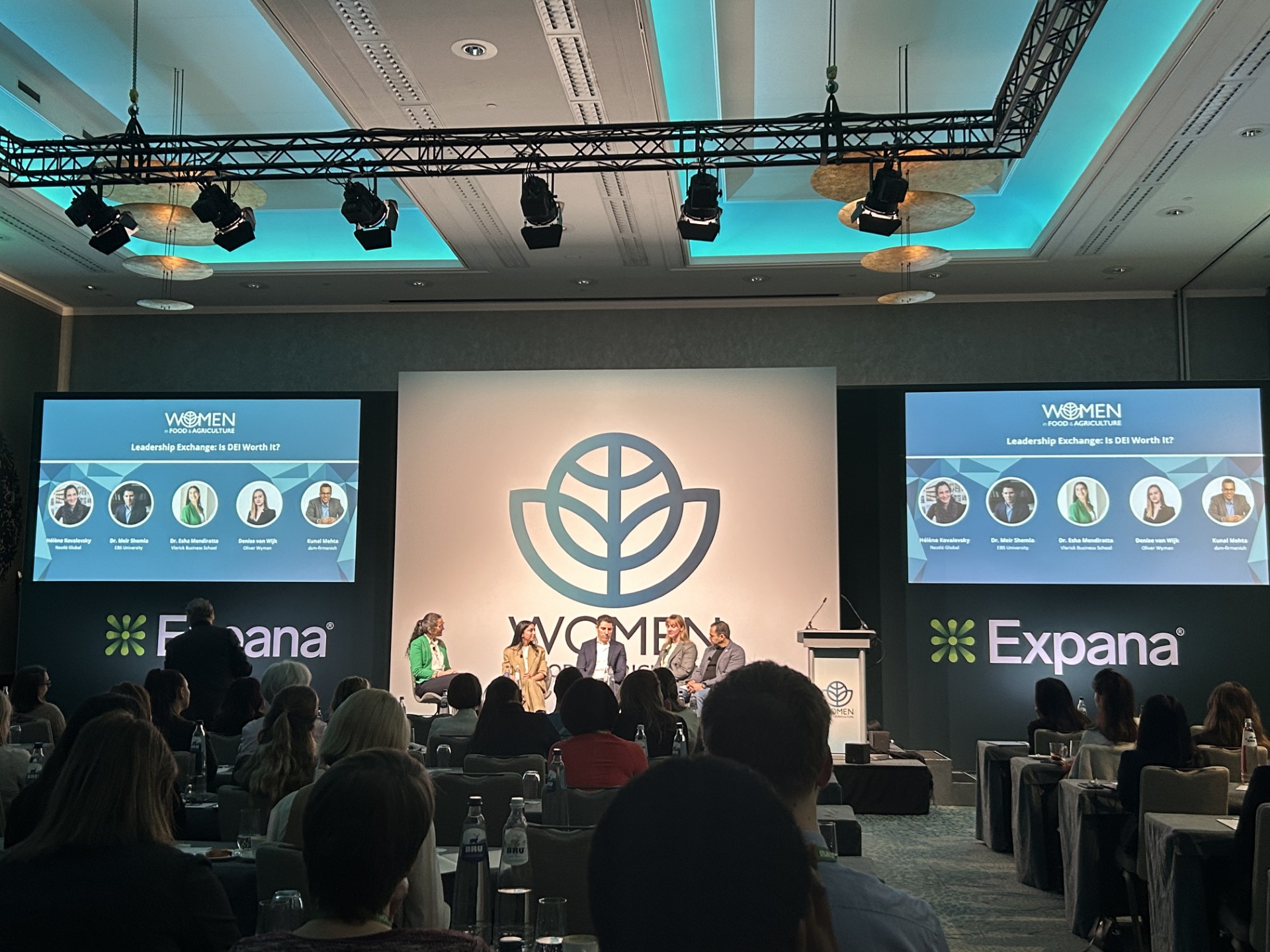
At Expana’s Women in Food and Agriculture event, senior executives and academics examined the commercial and cultural impact of diversity initiatives, with a keynote from Belinda May Ball, Managing Director for Global Sourcing at multinational supermarket chain ALDI SÜD, followed by a panel discussion on whether diversity, equity and inclusion (DEI) remains a business imperative.
The discussions reflected both advocacy for inclusion as a performance driver and caution over how DEI is measured and implemented.
In her keynote address, Ball framed diversity as a leadership and performance issue rather than a compliance exercise. “People are different and should be celebrated. The best teams I’ve been a part of have been a diverse group of people,” she said.
Reflecting on her early career, she acknowledged adapting her behaviour to fit traditional leadership norms. “Early on I thought I had to be like a man. Imitating people – that wasn’t genuine and didn’t deliver real results.” She argued that authenticity and empathy are commercial strengths. “Being empathetic doesn’t make you weak,” she said, adding: “Diversity is your strength.”
Inclusion as a mindset shift
Ball described inclusion as a mindset shift rather than a quick structural fix. “Ask questions. Find why people are different and understand. Performance is driven by difference. It’s not an overnight change. It’s a mindset.” She also emphasised talent development and recognition as central to leadership. “I love promoting people,” she said, highlighting the importance of rewarding hard work and supporting employees through difficult personal periods. “I like to treat people how I would like to be treated.”
Within ALDI SÜD, Ball is involved in SheLeads, a voluntary female leadership programme. The initiative drew 175 participants at its first event from within a department of around 800 employees. Over time, senior male leaders began attending and sponsoring sessions, broadening its internal impact.
The subsequent panel, “Leadership Exchange: Is DEI Worth It?”, explored whether corporate DEI strategies are delivering meaningful change. Panellists included Helene Kovalevsky of Nestlé, Denise Van Wijk of Oliver Wyman, Esha Mendiratta of Vlerick Business School, Meir Shemla of EBS University of Business and Law, and Kunal Mehta of dsm-firmenich.
Kovalevsky distinguished between representation metrics and lived experience. “Diversity is a demographic KPI. I believe that inclusion and belonging is much more relevant in expressing where we should be in the future,” she said.
Van Wijk warned that headcount alone does not reflect culture. “It’s very important we move beyond headcount,” she said, noting that survey data can be unreliable if employees lack psychological safety.
Mendiratta echoed this concern. “It’s well and good to do surveys but do people feel safe enough to answer,” she said, adding that responses can vary significantly depending on question framing. She called for deeper structural analysis, including examination of informal workloads and internal processes.
Shemla criticised the evolution of DEI into what he described as a numbers exercise. “DEI has become a headcount exercise and has been a disaster for the cause of DEI,” he said, arguing that organisations should tailor initiatives to their specific challenges rather than replicate standardised models.
What the evidence says
When the discussion turned to whether DEI is essential or optional, Van Wijk argued that evidence consistently supports its commercial value. “Every study, time and time again, has proven the benefits of diversity,” she said, particularly within food and agriculture where purchasing decisions are often influenced by women.
Shemla, however, cautioned that outcomes are not uniformly positive. “In studies 30% of cases have negative effects, lower cohesion, lower satisfaction etc,” he said, suggesting that diversity requires effective management to translate into performance gains.
Political developments in the United States were also raised, with speakers noting a shift in language and positioning among some companies.
Kovalevsky said: “The cost of DEI is real but so is the cost of exclusion. The real cost of the value chain is the cost of silence. Silence doesn’t solve problems.”
Mendiratta observed that some companies have reduced or reframed DEI terminology in response to politicisation, and that certain multinational firms now operate region-specific approaches. She warned this could affect talent retention. “Essentially I think the US is shooting themselves in the foot,” she said.
Van Wijk highlighted a gap between executive messaging and operational reality. “The message is clear at the top is that diversity is important. But when it comes to day-to-day activity, it’s pushed to the side,” she said.
Mendiratta concluded: “DEI is being politicised. There was a lot of appetite to discuss this 3 years ago.”
Across both sessions, speakers suggested that diversity initiatives in food and agriculture are at an inflection point. While the commercial case remains widely cited, the debate is shifting toward how inclusion is embedded in culture, how it interacts with political volatility, and how it can be measured responsibly. For industry leaders at the event, the central question was not simply whether DEI is worth it, but instead how it is implemented, and whether organisations are prepared to move beyond metrics to long-term cultural change.
Written by Fei Thompson