
The Egyptian strawberry industry recorded strong crop volumes for the 2025/26 season, thanks to supportive growing conditions. This was a change of fortunes, however, compared with the 2024 growing season, which faced extreme temperature fluctuations and erratic rainfall. Sources broadly describe an optimistic market outlook for the current season, with significant growth potential, but note that the industry faces several key challenges, including climate-related issues.
Egypt stands as the world’s largest exporter of frozen strawberries, exporting about 350,000 metric tons (mt) and controlling 27% of global market share in 2024 (latest data).
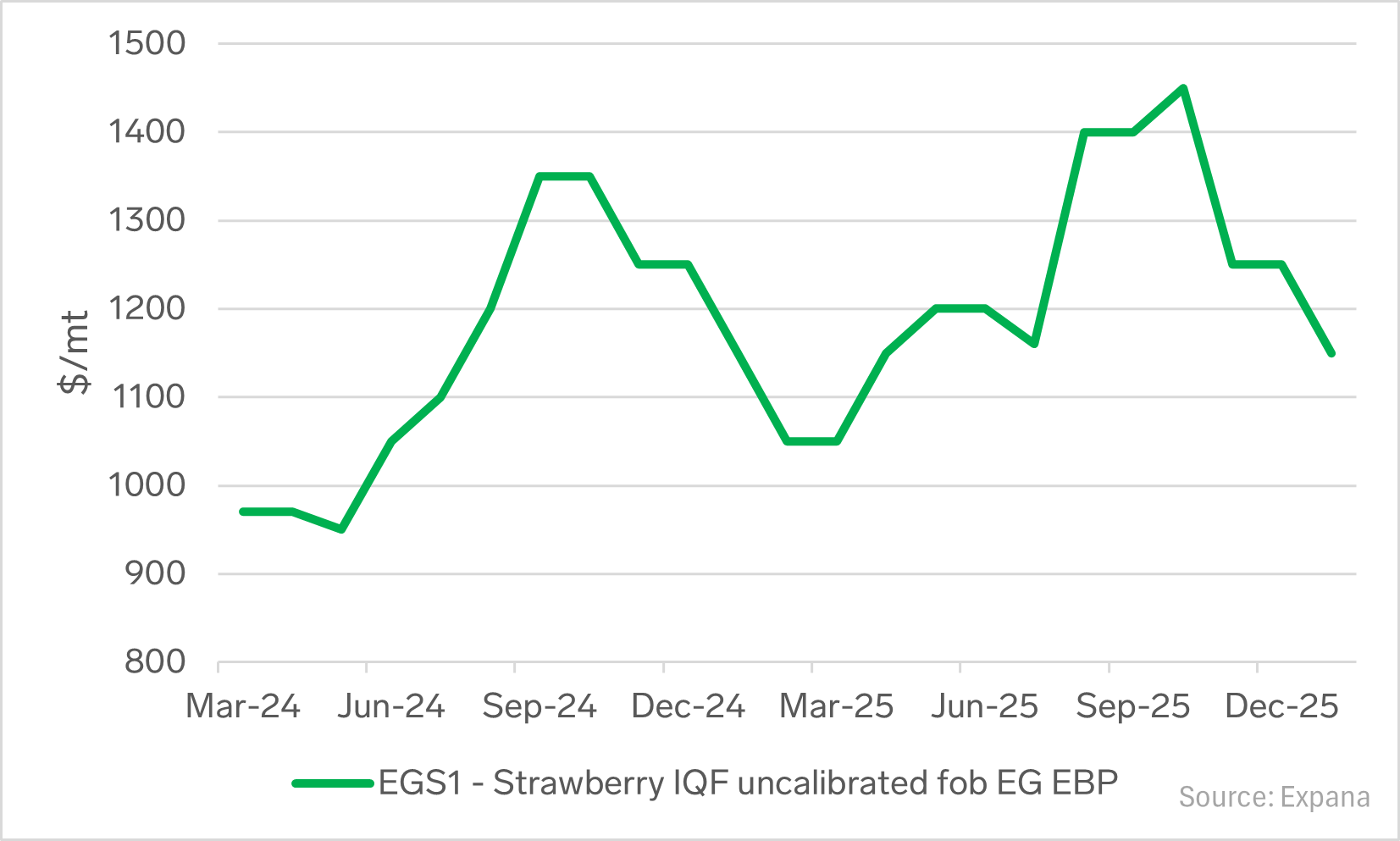
With the new strawberry season starting in November/December 2025, the successful harvest and ample supply have weighed on prices. Expana Benchmark Prices (EBP) for Strawberry IQF Uncalibrated FOB Egypt dropped by 8% m-o-m on January 30, to $1,150/mt.
However, climate-related challenges are of considerable concern in Egypt. Sources report that climatic conditions are increasing in extremity, with very high temperatures hitting the strawberry sector.
Against the backdrop of the difficult 2024 season, one industry participant stated: “Climate change seriously hampers the strawberry industry in Egypt…strawberries were very sensitive to weather conditions. Due to the high temperatures, the fruit ripened too quickly, which reduced its size and quality,” adding that costs increased for irrigation, nutrition, and pest control.
Regarding the 2025 season, industry participants state that although total acreage increased y-o-y, unpredictable weather conditions led to a lower yield per hectare, adding that the erratic conditions make planning especially problematic.
In addition, water scarcity is a major issue. According to the European Commission, “In Egypt, water security is an urgent priority: the country relies almost entirely on the Nile River, with per capita availability declining sharply due to population growth and climate change”, adding that over 70% of Egypt’s water is used in agriculture.
In response to the climate- and resource-related challenges, the Egyptian government has put several initiatives and regulatory frameworks in place. These include the National Water Resources Plan, a strategy to tackle water scarcity, originally by 2037, with its scope extended to 2050.
Some restrictive policies are in place in Egyptian agriculture. For example, Egypt currently has strict regulations in place for rice cultivation, a particularly water-intensive crop. Market sources do not currently expect any such restrictions or water-efficiency initiatives to affect strawberry production. However, some suggest that the government lacks a coherent, unified strategy to tackle climate-related challenges.
Early estimates for the 2025/26 season suggest export volumes of 360,000-380,000 mt for frozen strawberries, about a 3-8% y-o-y increase. However, some describe the industry as being at a crossroads. In addition to climate and resource-based difficulties, producers also contend with surging input costs and increasing global competition. Participants state that the sector will need to adapt to changing conditions, maintain a focus on quality, and invest in sustainability and technology. In addition, the government will need to establish a unified and more effective policy framework, sources state.
Image source: Adobe
Written by Craig Elliott