On November 25, leaders at the JM Smucker Co. fielded questions from investors during their most recent earnings call, which had to do with snacks performance, tariff headwinds, raw material pricing, and more. The big takeaway: Consumers largely looked past the increasing shelf price of coffee to continue brewing their daily drinks at home.
Coffee and tariffs were a hot topic for one of the biggest US coffee roasters, whose officials were asked about the recent US tariff relief (customer access only).
“We will be absorbing about $75 million of tariff-related costs incurred to date that we will realize, as I’ve noted in our third quarter,” said Tucker Marshall, CFO. “Therefore, an impact to this fiscal year, but a tailwind to next fiscal year.”
Still in 2025, price action was taken for Smucker’s coffee brands—where leaders increased shelf prices in May and in August 2025.
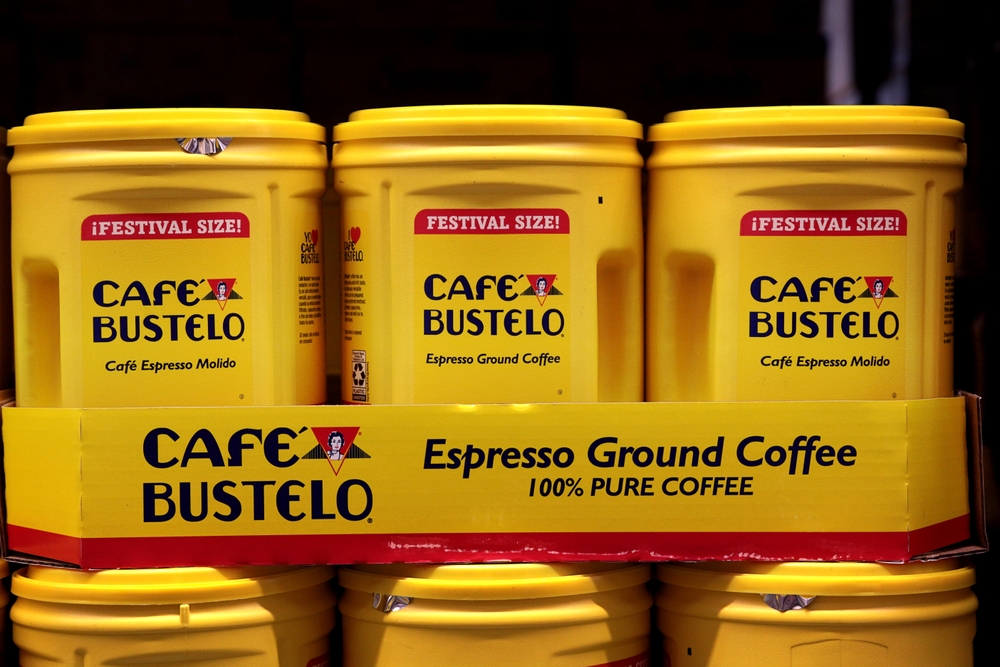
For example, customers saw Walmart’s shelf price for a 22-ounce can of Café Bustelo at $11.72 to start the year, and at $15.16 to close the year, according to Aisle Gopher. Despite price increases, Smucker’s leaders noticed stronger demand than they’d initially expected.
Still not clear is the procurement strategy by Smucker’s team. For example, high prices and tariff pressure on major suppliers like Brazil may have pressured Smucker’s leaders to utilize cheaper robusta coffee (from Vietnam where a trade deal had been reached) in production, rather than the record-high priced arabica coffee (customer access only). However, the exact formula for Folger’s or Café Bustelo coffee blends is not clear. What’s more, it’s not certain if consumers would respond to a change in the coffee blends.
“Our current outlook for the coffee portfolio is 16% year-over-year growth,” said Marshall. “And what’s embedded in that is 22% pricing, offset by 6% down volume/mix. That’s an improvement to when we stepped into this fiscal year where we thought growth would be 11% against 22% pricing offset by negative 11% of volume/mix. And so what you can see is our elasticity assumptions have improved from 0.5 stepping into this fiscal year to around 0.3 where we stand. And again, that’s on average over the year. So hopefully, that provides additional context as to the strength and resilience of our coffee portfolio.”
Assuming the US tariffs on coffee remain “off,” the company’s coffee profit margins are set to increase gradually, according to Smucker’s officials.
“We demonstrated an 18.2% second quarter segment profit margin in coffee. We would anticipate a slight improvement to that in our third quarter, but it will not surpass 20%. And then as you step into our fourth quarter, we should move beyond 20%. I don’t think that we’ll get all the way to 25% just as we continue to digest a lot of cost and cost inflation,” explained Marshall.
It seems that just like Expana’s team, Smucker’s management crew is of the opinion that raw material prices for coffee will fall in 2026. However, it’s still not clear when… With US tariffs “turned off” for coffee, market participants were already expecting a significant drop in the contract price. However, that marked decrease in coffee futures has not yet occurred, according to Expana (customer access only).
“Although we don’t have a clear view on to if and when that takes place as we get into a new coffee season, to the extent that we do see some meaningful deflation on the commodity, we would certainly pass that along to consumers as well. So I think the headline is, the portfolio itself offers a tremendous amount of options for consumers and notably value all the way to more premium offerings,” said Mark Smucker, CEO & Chairman.
Other Products & Markets
The JM Smucker Co. reported fiscal 2026 second-quarter net sales of $2.33 billion, up 3% year over year, or 5% excluding divestitures and foreign exchange. These results reflect prior divestitures of the Voortman business and certain Sweet Baked Snacks value brands.
Company leaders touted the “Sweet Baked Snacks” and particularly singled out the Hostess brand where certain products were eliminated, a facility was closed, while other products were added back like the Suzy Qs chocolate cakes. However, sales for these sugary snacks fell 19% to $256.1 million (−3% excluding divestitures).
“We had a three-pronged plan where we’re strengthening our portfolio by actually eliminating 25% of the SKUs, and we’ve seen really strong flowback into our core brands… of… Donettes and Cupcakes,” said Mark Smucker, CEO & Chairman.
Plus, Smucker’s management reiterated Uncrustables’ path to $1 billion in annual sales by year-end for the peanut butter and jelly sandwich brand. Leadership expects the brand to return to low double-digit growth in the back half, aided by new flavors and higher-protein items, improved retail placement, and strong momentum in convenience and away-from-home channels.
Pet Foods sales declined 7% to $413.2 million, while segment profit increased 2% to $124.4 million on lower costs and pricing.
Image source:
John Hanson Pye / Shutterstock.com
Written by Ryan Gallagher