
Key Takeaways
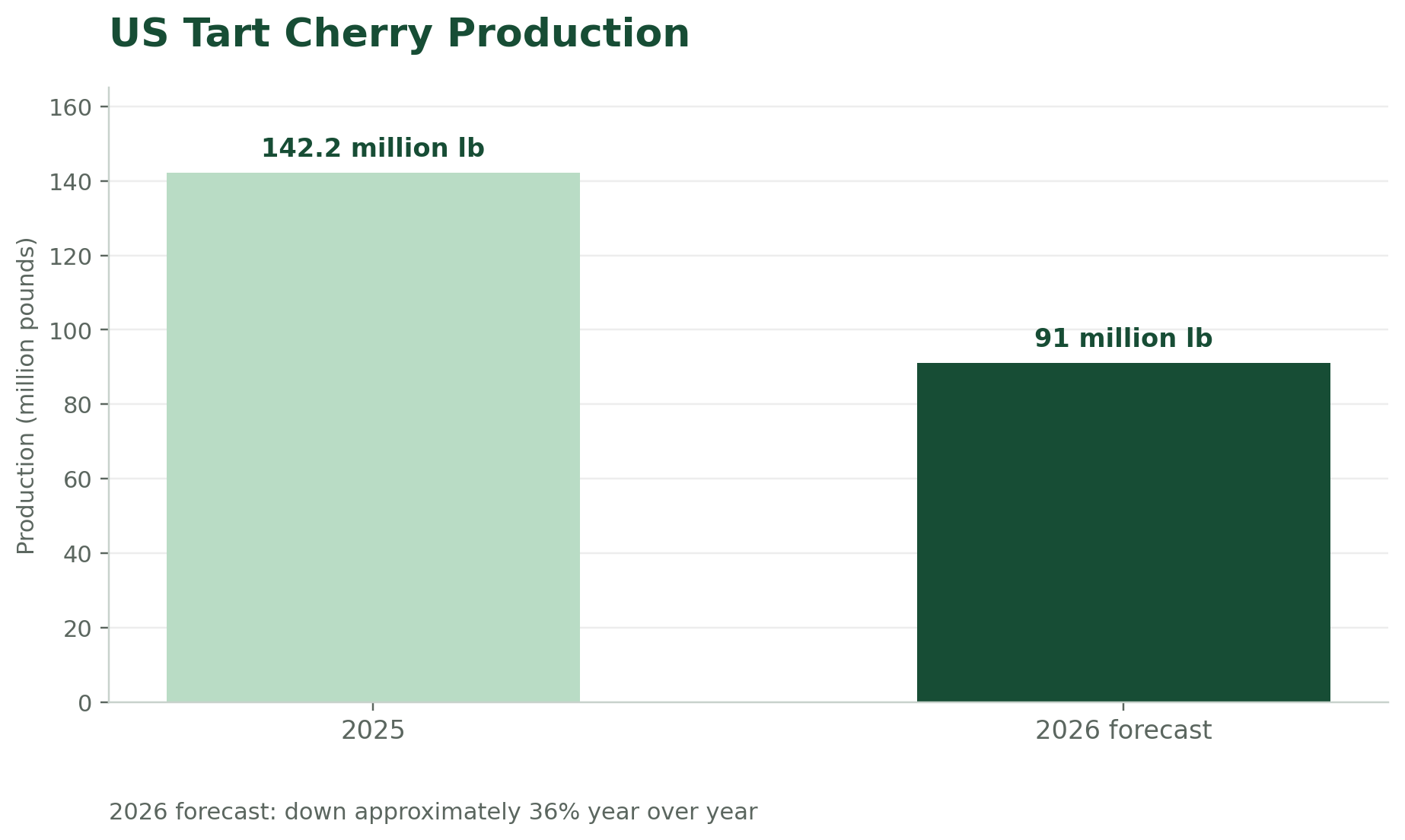
- US production down approximately 36% YOY, with the June forecast at 91 million pounds.
- Michigan and Utah face significant declines, with Utah production forecast to fall from 32.2 million to 7.9 million pounds.
- Limited carryover and global supply constraints increase competition for processing-grade fruit and create upward pricing pressure.
Source: USDA
According to the USDA’s National Agricultural Statistics Service (NASS) June 2026 Crop Production report, US tart cherry production is forecast at 91 million pounds, down 36% from 142.2 million pounds in 2025. Michigan production is forecast at 83.1 million pounds, compared with 110 million pounds last year, while Utah production is expected to fall to 7.9 million pounds from 32.2 million pounds. These are forecasts, not final harvested totals.
Freeze events during critical bloom stages damaged orchards in Michigan and Utah, the two leading producing states, has reduced 2026 supply. Lower production in Michigan and Utah also limits opportunities to replenish inventories following previous supply disruptions, increasing the importance of existing stocks and imported product in the overall supply picture. The reduced harvest follows an already challenging period for the industry. Lower production in 2025 limited opportunities to rebuild inventories ahead of the 2026 season, leaving the market more exposed to another shortfall. Because nearly all tart cherries are directed toward processing, reduced orchard output has direct implications for manufacturers of frozen fruit, juice concentrate, dried cherries and canned pie filling.
International supply conditions are also contributing to market uncertainty. European sour cherry producers entered 2026 following a difficult 2025 season, when frost damage reduced output in several growing regions. Continued weather-related production risks and uneven fruit quality may limit sourcing flexibility for processors seeking to supplement domestic supplies.
According to Expana market participants, domestic pricing heard for individually quick frozen (IQF) tart cherries is around $2.80/lb, while product originating from Poland is closer to $2.20/lb. With domestic production projected to be short according to the USDA and industry sources, the relationship between US pricing and imported Polish product remains an important factor in the tart cherry market. The extent to which imports can compete with domestic fruit will depend on availability, product specifications and delivered costs.
Image source: Adobe
Written by Holly Bianchi