
Key Takeaways
- June 2026 inshell-equivalent shipments totaled roughly 103.6 million pounds, up 48.8% year-over-year
- Year-to-date inshell-equivalent shipments through June reached roughly 1.399 billion pounds, up 25.4% from a year earlier
- The industry’s shipped and committed position stood at 102.0% of 2025/26 crop receipts at end of June
California walnut shipments continued their year-over-year advance through June 2026, with the industry’s combined shipped and committed position reaching 102.0% of 2025/26 crop receipts—surpassing total crop receipts for the first time this season—according to data released July 7 by the California Walnut Board. Kernel shipments are converted to an inshell-equivalent basis using a 42.5% crackout ratio throughout this analysis. Total inshell-equivalent shipments for the ten-month period from September 2025 through June 2026 reached roughly 1.399 billion pounds, up 25.4% from the prior-year period, a pace supported by the size of the 2025/26 California crop.
June 2026 Walnut Shipment Performance
Inshell shipments in June 2026 totaled roughly 9.6 million pounds, up 11.8% from roughly 8.6 million pounds in June 2025. Kernel shipments reached roughly 39.9 million pounds, up 54.1% from roughly 25.9 million pounds a year earlier. On a combined inshell-equivalent basis, June shipments totaled roughly 103.6 million pounds, up 48.8% from roughly 69.6 million pounds in June 2025.
June inshell-equivalent shipments declined modestly from roughly 105.3 million pounds in May 2026, with inshell volume falling from roughly 12.9 million pounds to roughly 9.6 million pounds while kernel volume edged higher from roughly 39.3 million pounds to roughly 39.9 million pounds.
Season-to-Date Shipments
Cumulative inshell shipments for the September 2025 through June 2026 period totaled roughly 302.0 million pounds, up 104.2% from roughly 147.9 million pounds in the same period a year earlier. Year-to-date kernel shipments reached roughly 466.4 million pounds, up 13.4% from roughly 411.3 million pounds. Combined inshell-equivalent shipments for the ten-month period totaled roughly 1.399 billion pounds, up 25.4% from roughly 1.116 billion pounds through June 2025.
Walnut Supply and Sold Position
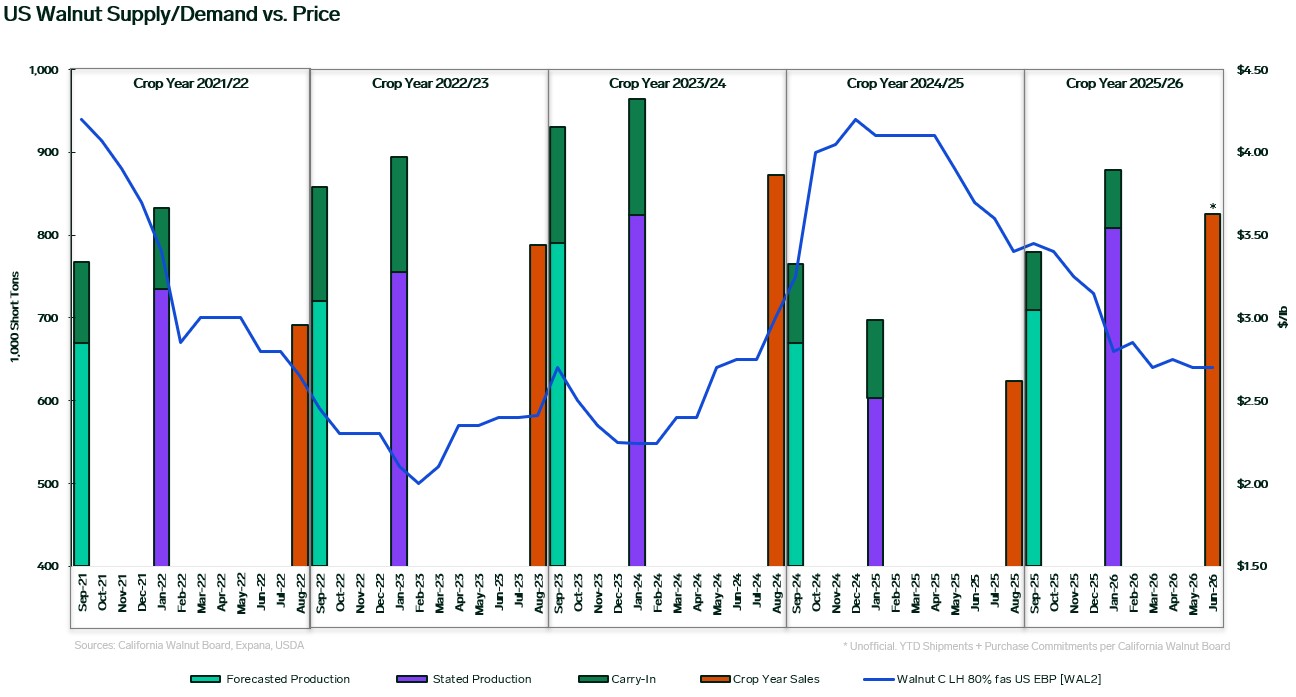
The 2025/26 season began with beginning stocks of roughly 69.6k short tons, or roughly 139.3 million pounds. Crop receipts totaled roughly 809k short tons, or roughly 1.619 billion pounds, of which roughly 98% was conventional and 2% organic. Combined with beginning stocks, total supply for the season reached roughly 879k short tons, or roughly 1.758 billion pounds.
The combined shipped and committed position at the end of June stood at 102.0% of crop receipts and 94.0% of total supply. Commitments exceeding 100% of crop receipts extend into beginning stocks in addition to the current-year harvest. Market sources suggest the incremental volume sold beyond crop receipts reflects draws on existing inventory, which could reduce the season-ending carryover. Multiple sources report having neither executed nor heard of any new-crop sales at this point in the year, suggesting the overage is not attributable to forward commitments on the 2026/27 crop. Open commitments at the end of June totaled roughly 252.6 million pounds inshell-equivalent, consisting of roughly 9.5 million pounds inshell and roughly 103.3 million pounds kernel, equivalent to roughly 243.1 million pounds inshell.
Product Mix
Kernels accounted for 90.7% of total inshell-equivalent shipments in June 2026, compared with 87.6% in June 2025. On a year-to-date basis, the kernel share of 78.4% compares with 86.7% through June 2025, reflecting proportionally stronger growth in inshell volume across the season.
Walnut Market Tone
Market participants describe trading activity as subdued late in the marketing season, with available supply largely allocated as the industry’s sold position has surpassed crop receipts. US exporters have noted the recent reduction in EU tariffs with measured optimism, describing the development as providing additional market certainty and stable access to a key destination for California walnuts. Participants have not characterized the tariff reduction as having an immediate effect on trading volumes or prices, but note it offers a constructive backdrop for commercial relationships as the industry turns its attention toward the upcoming season and new-crop supply estimates.
Find more information on Expana’s nut commodity coverage here.
Written by Nick Moss