
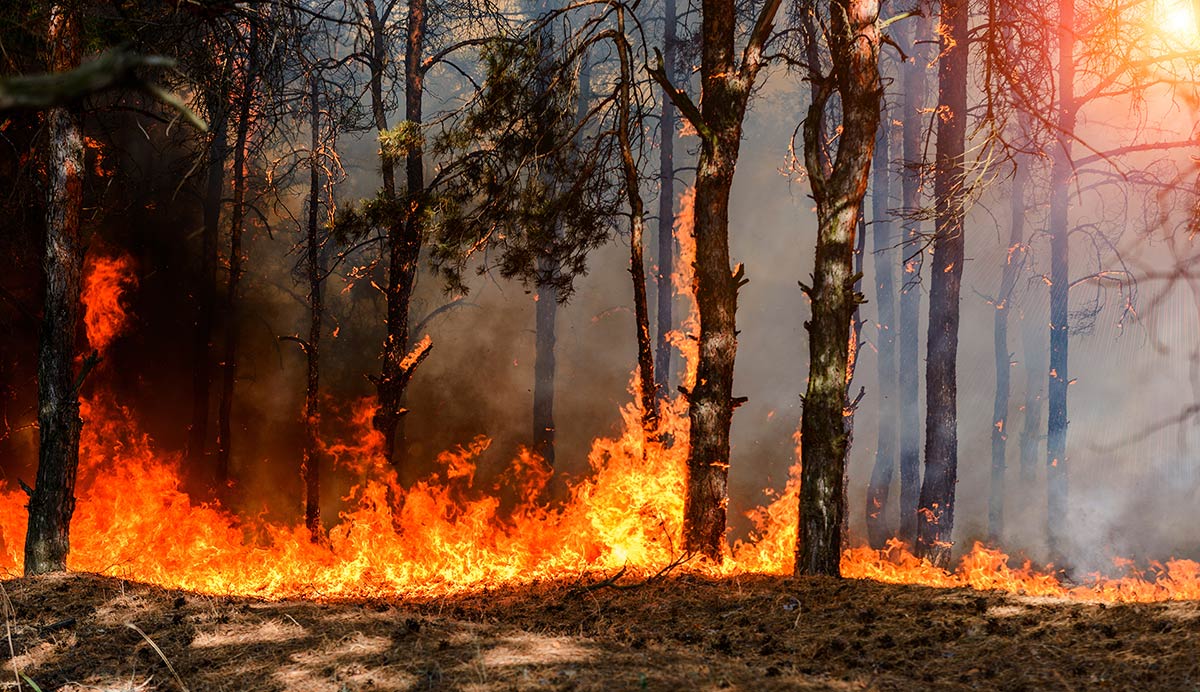
Europe’s 2026 wildfire season is increasingly becoming a commodity market issue, with major fires in France and Spain adding to crop stress already caused by repeated heatwaves, drought and tightening water availability. The scale is no longer negligible: according to the European Forest Fire Information System (EFFIS), around 435,000 hectares had burned across the EU by the end of July, roughly triple the recent historical average, while fire-weather severity for the year to date was reported to be 43% above the 20-year average. While direct agricultural losses remain localised, the timing is critical: fires are hitting during a period when many of Europe’s key growing regions are already under pressure, increasing risks to both yield and quality across several markets.
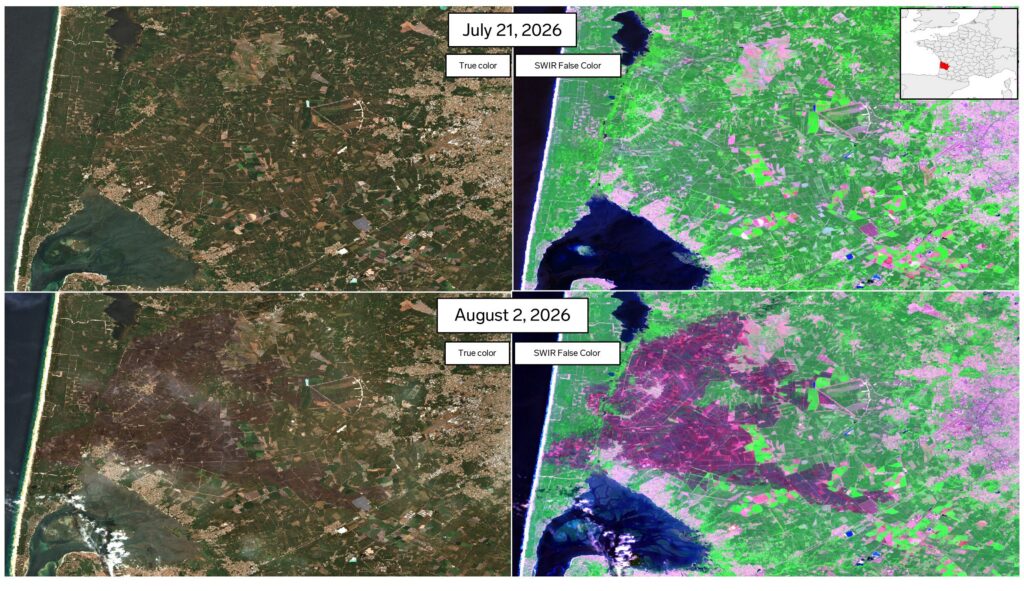
Before and after images of the Gironde wildfire near Bordeaux, France, using Sentinel-2 satellite images. SWIR false-color composite images (B12-B8A-B4 RGB), are provided to highlight the burned land, represented by the deep pink and red colors. Source: HLS Sentinel-2 Multi-spectral Instrument Surface Reflectance Daily Global 30m v2.0, distributed by NASA LP DAAC
The strongest immediate exposure is in Mediterranean perennial crops. In France, fires near Bordeaux have raised concern for vineyard areas, where the market risk extends beyond direct burn damage to include smoke exposure and quality deterioration. The Gironde fire near Bordeaux has burned around 40,000 hectares, making it one of the largest single wildfires in modern French records. In Spain, large fires have compounded stress in olive, wine, fruit and cereal-producing regions already dealing with high temperatures and poor moisture conditions. That makes the threat more significant for olive oil, wine grapes and fresh produce, where supply is often more sensitive to quality issues than outright volume losses.
The wider concern is that fire activity is now overlapping with a broader drought and heat pattern rather than remaining an isolated hazard. In southwestern France, World Weather Attribution analysis found the peak seven-day fire weather conditions seen this July were roughly a 1-in-22-year event in today’s climate. In central Spain, similarly severe conditions were closer to a 1-in-6-year event, with such fire-weather conditions now estimated to be at least 20 times more likely than in a pre-industrial climate. The same analysis showed that both France and Spain moved from a relatively wet winter into abnormally low surface soil moisture during spring, with deficits persisting into summer, a key signal that the landscape has been drying for months rather than days. Fire activity has also been visible further east, including in Hungary, underlining that this is part of a wider regional fire-weather pattern rather than a problem confined to Iberia and southwestern France.
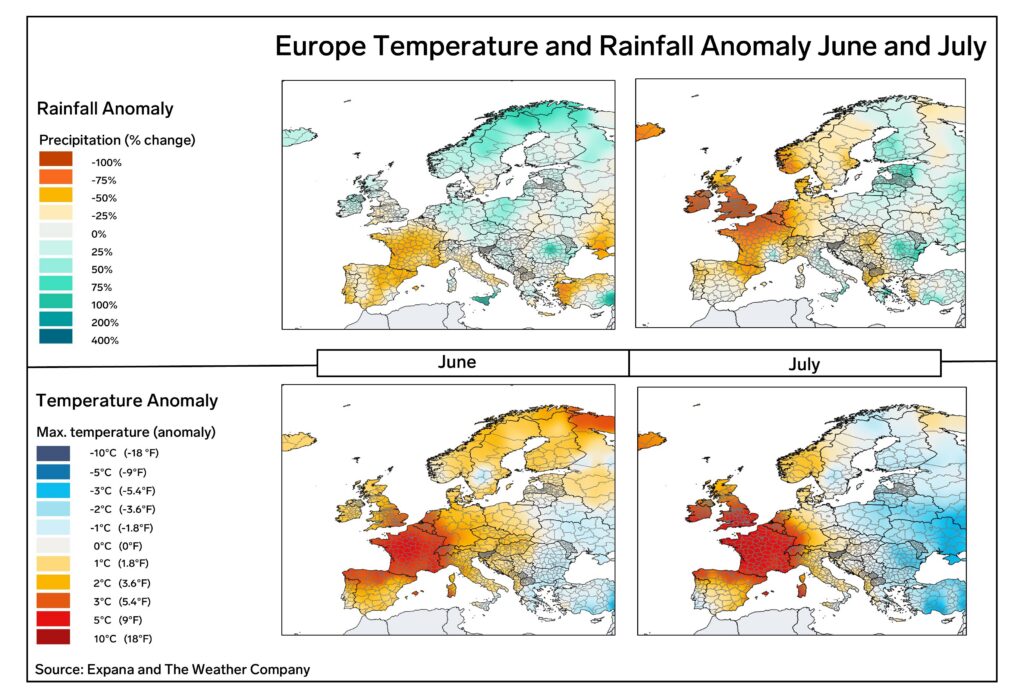
Precipitation and average max daily temperature anomaly from the 30-year average, across Europe in June and July
That matters for agriculture because the same hot, dry pattern driving wildfire risk is also eroding crop potential more broadly. In Spain, France, Italy and Greece, fire-prone conditions are coinciding with lower water availability and worsening pressure on fruit, vegetables and pasture. For wheat, barley, maize and sunflower, direct fire losses may remain secondary, but the underlying heat and moisture deficits are more market-relevant, raising the risk of reduced yields, lower quality and more difficult harvest, storage and transport conditions.
Pasture is another area to watch closely. Burned grazing land, combined with prolonged dryness, can tighten forage availability and add pressure to livestock systems. In turn, that can increase demand for feed grains at a time when some grain-producing regions are already under stress from drought and heat.
For markets, the key question is no longer only whether fires directly damage a crop region. It is whether the broader fire-weather environment is worsening supply conditions across an entire agricultural zone. That is especially important in Europe, where crop production is regionally concentrated and where quality-sensitive commodities such as grapes, olives and horticultural produce can be affected even when flames do not reach fields directly.
In market terms, the fires do not yet point to a broad price shock, but they do add upside risk across already weather-sensitive commodities. For grains, direct wildfire damage is still likely to be too limited to shift European pricing on its own. The greater relevance is as an additional layer of stress on crops already facing heat and moisture deficits. For wine, olive oil and fresh produce, the impact could be more pronounced, as localised fire or smoke exposure can reduce quality and tighten availability in higher-value segments even without major outright production losses.
If heat and dryness continue through August, wildfire risk is likely to become a more meaningful market factor for wine, olive oil, fresh produce, pasture and some grain markets. The main issue for now is not widespread crop destruction, but the way persistent fire-weather conditions are adding to existing drought stress and reducing the margin for recovery in vulnerable producing regions.”
Written by Max Turnbull