
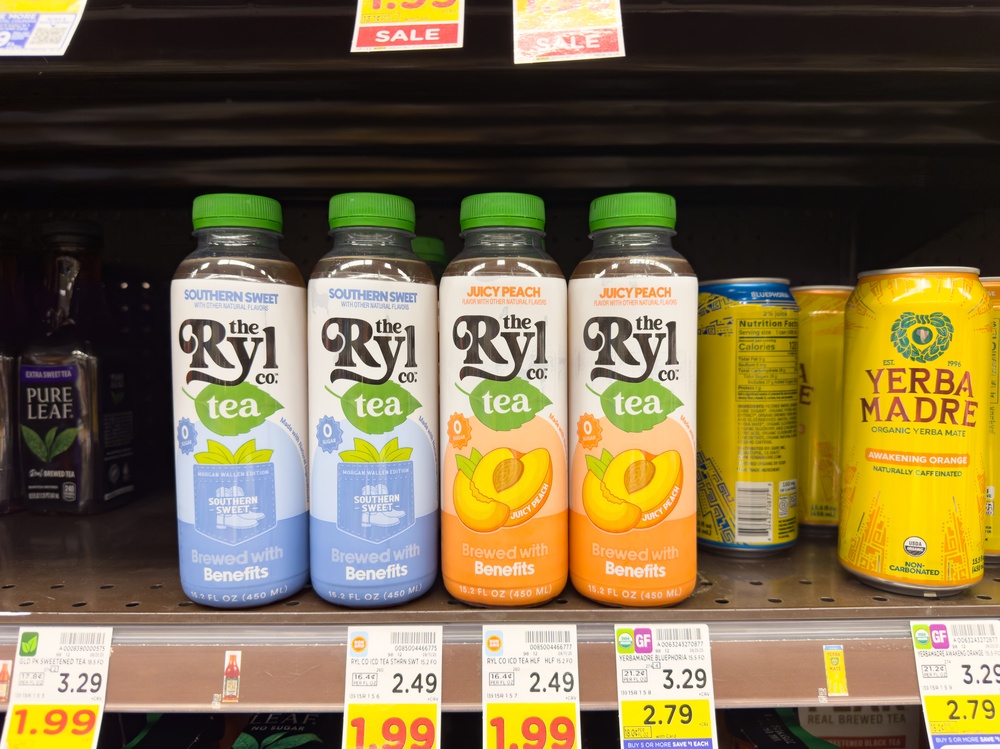
The US ready-to-drink (RTD) tea market is showing signs of generational change as newer companies chip away at dominant legacy brands, according to Blodin Ukella, founder and CEO of The Ryl Company. As of a mid-July 2026 interview, younger consumers are increasingly looking for zero-sugar and functional beverages, while older consumers are aging out of the market, he said.
“RTD teas have generally been sugar and sweetener forward,” explained Ukella, noting some of the market shifts.
In recent years, however, brands have entered the market offering zero-sugar, better-for-you options that are often sought out by younger consumers in the Gen-Z and Millennial age group, according to Ukella.
Tea remains one of the largest nonalcoholic beverage categories, with RTD products accounting for most consumption—as flavor-seeking consumers are generally not interested in steeping their own tea and would rather reach for grab-and-go options.
“We started to see emerging brands… with natural sweeteners and lower sugar options—that trend regained some legs. At the same time, we saw the market dipping again—maybe 1-3% a year mainly driven by the larger legacy tea brands that have leveraged more traditional tea ingredients, like sugar and artificial sweeteners,” suggested Ukella.
Partly, changes to consumer demographics were forcing that shift in the RTD tea market. For years, the Baby Boom generation was the backbone of food and beverage spending. Now, that’s changing.
“Shopper panel data showed age behavior as a major opportunity in the category: As that younger population grows, spending behavior changes across the marketplace, because they eventually make up more of the overall basket size for category spending. We found that 76% of RTD tea buyers were part of the legacy shopper generation, and… [their] category spending went down.”
So, as Boomers age out as the main shoppers, spenders, and drinkers of products like RTD tea, the habits of newer generations are taking hold.
Mainly, that shift spurred softness in the broader canned and bottled tea category, which is still heavily controlled by major beverage companies and legacy brands such as Arizona, Brisk, Snapple, Gold Peak, and Lipton.
“Having said that, most tea products are still similar to what has been the status quo,” continued Ukella. “But new, modern energy drinks geared toward the younger crowd, like Celsius, capitalize on shoppers who want less sugar, as well as a cleaner, functional benefit day-to-day.”
So, Ryl is adapting to the latter part of the tea and greater non-alcoholic beverage market by using less artificial sweeteners like sucralose and aspartame. Instead, Ryl teas are sugar-free and sweetened with monk fruit and stevia leaf extracts.
“Tea is functional; it has polyphenols which behave similarly to traditional antioxidants and help reduce things like free radical load build up,” he explained. “But bottled tea is so processed, it degrades the efficacy of that functional profile during the manufacturing process. So, we try not to abuse the liquid. We try to keep and add back to that functional profile… We use the natural functional content to get a full spectrum of tea profiles.”
Tea Market Origins, Pricing, and Trade
Ukella described tea leaf supply as relatively resilient versus other soft commodities. Black and green tea can be sourced globally, helping his team manage origin risk.
For example, in May 2026, Indian tea averaged USc 319/Kg, up 58.7% from February 2026, as demand improved and supply for quality leaves tightened, according to Expana’s quarterly tea report by Market Reporter, Sammy Rolls.
Kenyan tea averaged USc 218/Kg, down 6.8% from February but still 13.9% higher year over year (YOY), while Sri Lankan tea averaged USc 368/Kg, down 2.1% quarter over quarter and 5.4% YOY.
At the same time, freight, storage, and tariffs remain key cost variables—despite Ukella and the company’s hedging plans against those costs.
“In 2025, before tariffs were imposed, we locked into large volumes before it was imported,” he said. “It was scary at the time, but since then we’ve had no recent exposure to tariffs.”
Otherwise, the business has been able to drive growth as tea leaves are light and have a long shelf life to ensure lower shipping costs, he shared.
“One major variable is that climate is uncertain,” reminded Ukella. “Also tea types can be inconsistent… In general, in black tea there’s not much variability. But the more specialized you go; there’s less volume and more pricing variance.”
However, tea is more resilient than other commodities in the macro environment,” said Ukella who alluded to coffee’s volatility. “[Coffee] gets stuck in locations, there’s been tariffs, blockades, and coffee is way more sensitive to environmental and climate changes… it’s maybe not as resilient as the tea leaf.”
Looking ahead for the Ryl business, thus far, RTD tea household penetration is high, according to Ukella’s team. Still, the category remains weighted toward older shoppers, while Gen-Z and Millennial consumers are gravitating toward newer beverage formats.
Most recently, Ryl’s team closed a $20 million Series C round, which the company said will support retail expansion, distribution, and product innovation. For example, Ryl Tea grew 157% while the overall category declined 1.8%, according to Ryl’s recent Series C funding announcement that cited Circana data.
“We have enormous respect for the brands that built this category over the last several decades—they’re the reason tea has become a staple in the majority of American households. Our mission is to help bring a new generation of consumers into the tea aisle and grow the overall category through products that align with how people want to drink today,” said Ukella. “We’re incredibly grateful to our team, our retail and distribution partners, our investors, and the consumers who’ve believed in what we’re building. This round gives us the opportunity to fuel that momentum.”
Image source: The Image Party / Shutterstock.com
Written by Ryan Gallagher