

Key Takeaways
-
China’s 205,000 MT annual beef quota fully exhausted in record time
-
55% out-of-quota tariff activates, offal exempt
-
Australian exporters pivot as Korean quota also closes fast
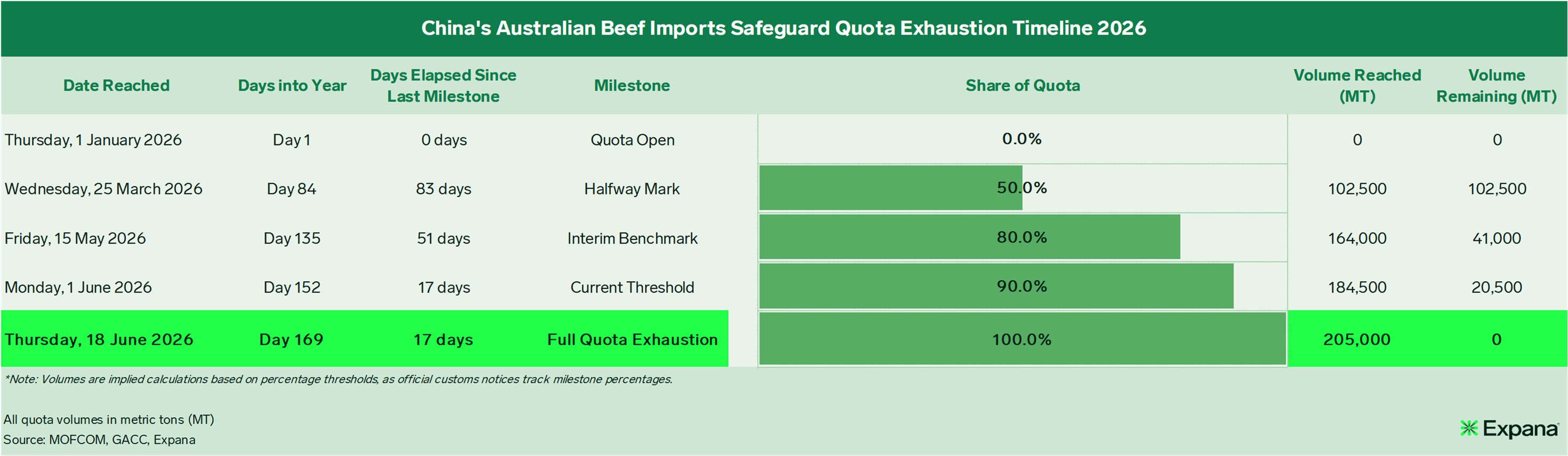
Australia has burned through China’s entire 205,000 MT annual beef safeguard quota as of June 18 in just 169 days, triggering a 55% over-quota tariff that curtails large-scale viable trade for the remainder of 2026.
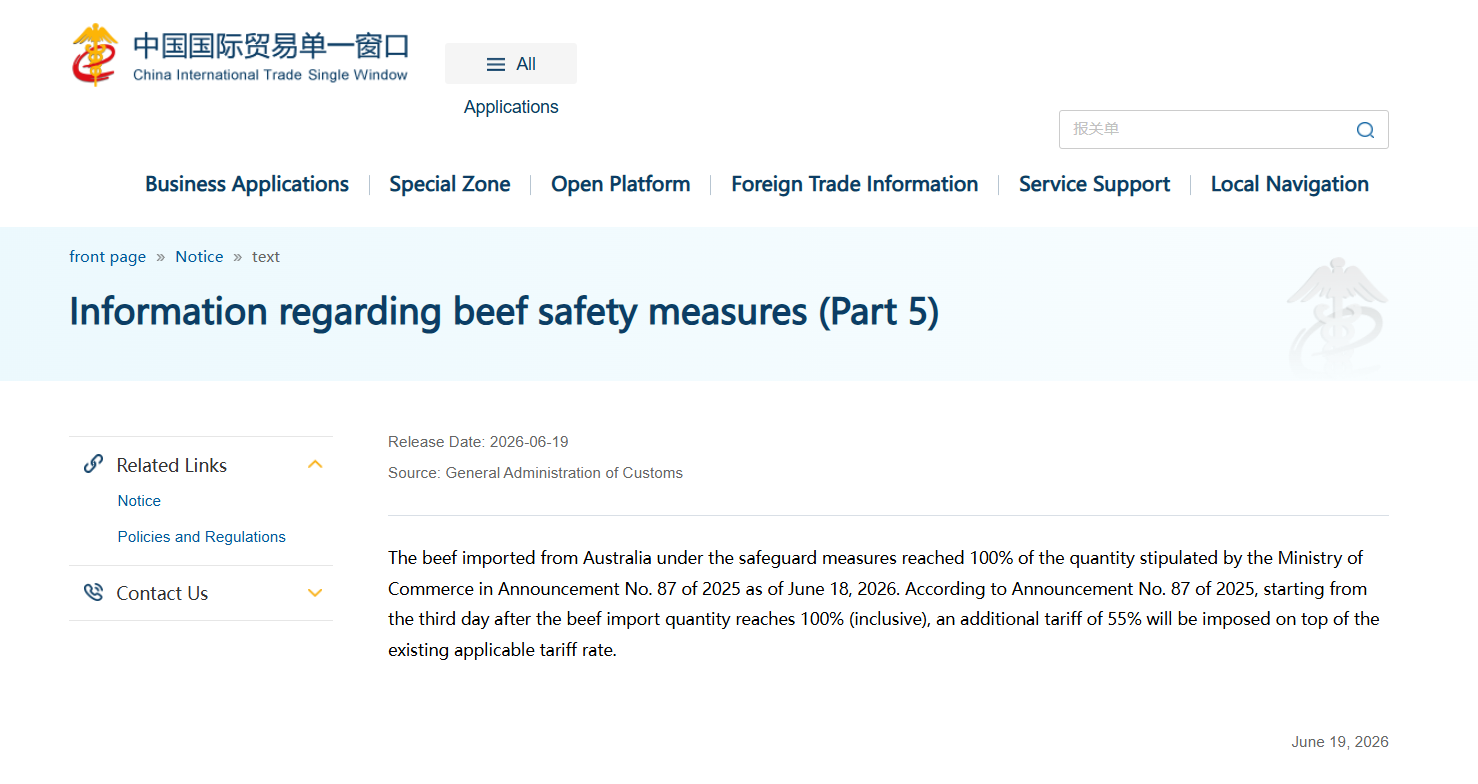
The threshold was confirmed via the China International Trade Single Window portal late on Thursday, under enforcement mandates issued by the General Administration of Customs (GACC) and the Ministry of Commerce (MOFCOM) under Announcement No. 87 of 2025.
The announcement aligns with market expectations of a mid-June trigger. This June 18 date falls 37 days ahead of the July 25 milestone recorded in 2025, and a massive 110 days ahead of the October 6 milestone from 2024.
The 55% Tariff Hammer Falls
The over-quota 55% tariff penalty activates automatically on the third day (inclusive) at 12.00 am following the official date of quota exhaustion. Cargoes en-route are not exempted.
This restrictive duty supersedes the standard 12% safeguard rate applied earlier in the trade cycle and effectively voids the zero-tariff preferences originally negotiated under the China-Australia Free Trade Agreement (ChAFTA).
Under ChAFTA provisions, however, the safeguard restriction excludes beef offal, which continues to enter China tariff-free.
This 55% penalty instantly eliminates commercial margins, dampening the appetite for further shipments.
However, this safeguard tariff outcome was not unexpected.
Importers had aggressively front-loaded purchases from the start of the year in anticipation of early quota exhaustion, a dynamism that itself accelerated the record pace of drawdown.
A final wave of time-sensitive cargo moved via air freight to beat the deadline, but regular supply chains are now pausing.
With China market conditions unfavorable for the remainder of the year, Australian exporters are already redirecting supply to alternative global markets.
The United States (US) and New Zealand stand to capture a portion of the displaced demand in the interim, as New Zealand’s China quota remains largely intact and the majority of US beef import licenses newly renewed.
Late Q3 now emerges as the next likely juncture, when Australian beef negotiations for the next quota year are expected to begin.
Alternative Markets Under Pressure
Australia’s country-specific allocation under the Korea-Australia Free Trade Agreement (KAFTA) is also closing fast.
With close to 90% of the Korean quota already exhausted amid heavy parallel drawdowns, Australian exporters face tightening options across major North Asian trade lanes.
Written by Junie Lin, Joe Muldowney and Bill Smith