
Key Takeaways
- Seasonal patterns are real, not random — harvest cycles, weather, and consumer habits repeat because the forces behind them don’t change fast.
- Inventory tips you off early — stock building or drawing differently than usual is often the first sign a pattern is shifting.
- Not all breaks are equal: temporary (self-corrects), gradual drift (recalibrate your baseline), or permanent reset (throw out the old data).
- Timing beats hindsight — knowing if this year’s pattern is ahead, behind, or breaking changes when and how much to buy, before prices move.
- Ribeye 2024 = the playbook — prices stalled ahead of BBQ season, then caught up in H2. Classic temporary break.
- Expana tracks the live picture — Market Watch shows where this year sits vs. history; Expana IQ’s models anticipate seasonality, not just reflect it.
Why seasonal commodity price patterns exist, and how they change over time.
Gas prices rise in winter. Fruit prices shift with the harvest. Beef demand spikes around the holidays and grilling season. These rhythms are real. They repeat year after year because the forces behind them (growing seasons, weather, consumer habits) don’t fundamentally change.
But those forces do shift. Not overnight, and not all at once. Over time, how supply and demand are structured in any market evolves. When that happens, the seasonal patterns buyers have relied on can drift or break.
Why seasonal patterns exist
The clearest cases are harvest-driven. Agricultural supply concentrates in specific months, pushing prices down at harvest as supply peaks and up as stocks draw down in the months that follow. Weather shapes this further, affecting yields, timing, sometimes both in the same year.
Demand follows its own calendar. Heating fuel spikes in winter. Grilling season reliably drives beef prices. These cycles hold because the behavior behind them (how people heat their homes, when they buy for summer) doesn’t change quickly.
Inventory connects the two. Stocks build when supply runs ahead of seasonal demand and draw down when demand outpaces supply. That cycle reinforces the price rhythm. It also makes a shifting pattern visible early. When inventory is building or drawing differently than usual, the pattern is already moving.
How patterns change
Seasonal patterns change in different ways, and at different speeds.
Some breaks are temporary. An unusual weather year pushes a harvest earlier or later. A demand spike runs hotter or cooler than expected. The pattern breaks, then recovers, often returning close to the historical norm the following year.
Others are more gradual. New supply regions come online. Consumer preferences drift. Climate shifts alter growing season timing year by year. These changes don’t announce themselves. They show up as a pattern consistently running different from its historical shape: smaller moves, different timing, a magnitude that no longer matches what the data used to suggest.
Occasionally a pattern resets more permanently. A structural shift in supply or demand (a major new production region, a lasting change in consumption behavior) means the old seasonal shape no longer applies.
That distinction matters. A temporary break calls for patience; the window to act on the pattern often reopens. A gradual drift means the historical baseline needs recalibrating. A permanent reset means the old seasonal data is no longer a reliable guide at all.
Seasonality in action: Ribeye prices
Wholesale ribeye prices typically rise before summer BBQs and the holiday season as buyers stockpile, then fall once demand eases. In recent years, that pattern held.
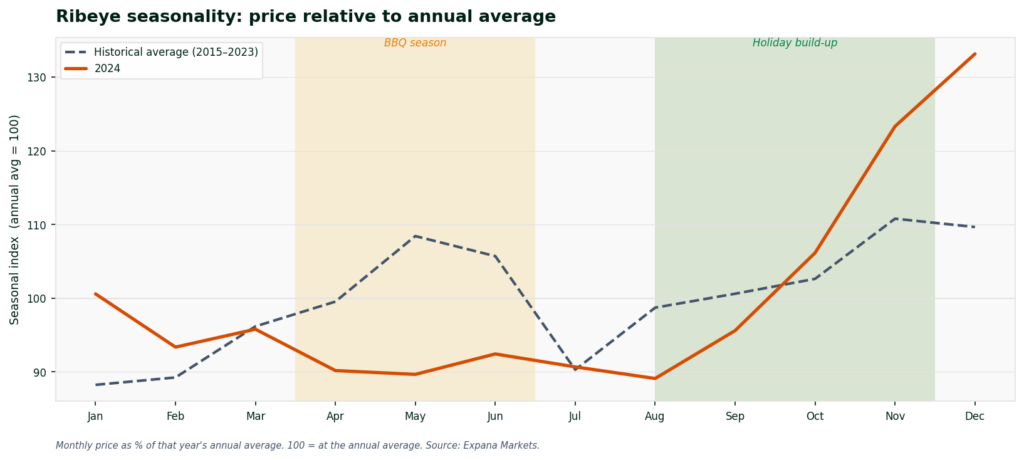
But in early 2024, prices didn’t follow the typical script. They stayed flat heading into BBQ season instead of climbing. The pattern broke, returned in the second half of the year, and left buyers who relied on history without much to work with during those months.
In this case, it was a temporary break. The broader pattern was intact, and it returned in H2. But identifying that in real time, rather than after prices had already moved, is where timely insight adds the most value.
Why does it matter?
Knowing a seasonal rhythm exists is the starting point. The more useful question is whether this year’s pattern is on track, running ahead, or diverging in a way that changes the picture for the months ahead.
The seasonal picture informs timing and sizing. It can show how much of the historical window may remain, and how the scale of an expected move compares with the norm.
These inputs matter most when they’re available ahead of a decision, not as a retrospective explanation of why prices moved.
How Expana approaches it
At Expana, seasonal dynamics are built into how we analyze and forecast commodity prices across agri-food markets. Our seasonal analytics, available in the Market Watch section of our core forecasts and embedded within Expana IQ‘s model-based forecasts, shows where the current year’s price movement sits relative to historical norms, so you can see clearly whether a seasonal move could be on track, running ahead, or not materializing.
This analytical view feeds into how our analysts build their market assessments and flow through to the wider range of algorithmic forecasts derived from that expert foundation. In Expana IQ, the models learn the underlying seasonal patterns and dynamics of each market, using that understanding to shape how future prices are forecast, not just reflecting history, but suggesting how seasonality may evolve.
That gives procurement teams a more grounded basis for sourcing decisions: timing purchases against an expected seasonal move, sizing coverage based on how the pattern is tracking, or understanding what the seasonal component implies for the forward price. The live picture, not just the historical one.
For more information on Expana’s forecasting methodologies and insights, request a demo.
This commentary is prepared by Expana and its group of companies, neither of which is an investment firm. We have no positions in the commodities or derivatives referenced. The views expressed are for information only. See our disclaimer for more information: https://www.expanamarkets.com/disclaimer/
Written by Andrei Rjedkin