
Key Takeaways
- The pressure on procurement has changed structurally, not cyclically. The last five years aren’t a difficult patch that experienced teams can wait out. They represent a fundamental shift in how commodity volatility works – and accumulated expertise and supplier relationships no longer insulate procurement leaders like they once did.
- Some risk simply cannot be neutralised. Categories like fresh beef trim carry exposure that financial instruments can’t adequately hedge. When prices move sharply, procurement absorbs the reputational fallout for outcomes the market determined — not the team.
- The role has quietly become an internal communications job. A growing share of procurement leaders’ time is now spent translating market conditions to finance, sales, and executive teams. This translation burden is central to the role but almost never recognised in job descriptions or performance frameworks.
- The real cost lives in the intelligence gap. The distance between what procurement understands about market dynamics and what the rest of the business can act on erodes trust, distorts accountability, and hollows out experienced teams over time.
- Forward visibility changes the nature of every internal conversation. Getting ahead of market movements — framing where costs could go, not just explaining where they went — is what separates procurement functions trusted at leadership level from those perpetually playing catch-up.
- This is a structural problem, not a personal one. The leaders best positioned aren’t necessarily the most experienced. They’re the ones with access to credible directional intelligence before the numbers move.
Why procurement leaders are running out of room, and what the rest of the organisation needs to understand
The meeting starts the same way it always does.
The numbers on the slide are accurate but the market context behind them is missing beef cutout prices moved by nearly 20% year on year in late 2025.
For a business spending £10m annually on beef, that is not a forecasting variance, it is a structural budget problem.
Finance wants to know why procurement didn’t see it coming. Procurement knows the answer. The problem is the answer takes forty minutes to explain, and the meeting is already running long.
This is where the cost begins. Not on the trading floor. In that room.
The pressure has changed in kind, not just degree
Senior leaders across food and beverage manufacturing are consistent on one point: the last five years represent a structural shift, not a cyclical one.
Thirty years of experience means accumulated pattern recognition, hard-won supplier relationships, and a toolkit that is refined across buying cycles. All of that experience doesn’t protect you the way it used to though.
It is not the pressure of a difficult negotiation. Not a tight deadline or a missed saving target. It is the pressure of being held accountable for outcomes the market is determining. Not the team. Not the strategy. The market.
Most organisations haven’t caught up with what that means for the people carrying it.
Some risk cannot be neutralised. The accountability remains.
Fresh beef trim is one of the hardest categories to manage in food procurement. Price swings are severe and irregular. Seasonality, once a reliable planning anchor, has become inconsistent. The financial instruments available to offset fresh trim exposure are limited and are often ineffective. That leaves the team holding risk it cannot neutralise.
When prices move, and they do, sharply, without warning, forecasts miss. Inside the business, the question is rarely about what the market did. It is about what procurement did.
That framing persists even when the outcome was never within the team’s control. Long after the moment has passed, it shapes how the function is perceived.
The role has quietly become something else
A growing share of their time is not spent with suppliers. It is directed inward at finance, sales leadership, executive teams who need to understand why costs moved and what the options are.
This translation function is now central to the role. It rarely appears in job descriptions.
A tariff change. A disease outbreak in a supply region. An unexpected weather event. Each has to be explained not just as a fact, but as context, context that makes the cost impact understandable and the team’s response credible.
When that context is missing, forecast misses become personal rather than structural. The team absorbs the reputational cost of conditions it did not create.
The consequences are not abstract. Margin erodes. Supplier relationships weaken.
The experienced leaders who carried institutional knowledge for a decade quietly decide it is no longer worth it. The function doesn’t fail dramatically. It hollows out.
What changes the conversation
Not goodwill. Not better internal meetings.
Shared intelligence.
What procurement leaders describe wanting consistently is not more data. They want a shared frame. They want a way to bring finance, operations and leadership into the same forward-looking view of where markets are heading and why.
Two observations from the industry point to the same conclusion, from different angles:
“An invaluable tool that supports a whole range of activities from top line communication and reporting to market-based or cost-model negotiations.” Group Procurement Director
“They provide our commercial functions, from frozen to fresh and packaging, with one absolutely critical version of the truth.” Former Senior Buying Manager, Tesco
Top line communication. These are not product endorsements. They are descriptions of a structural problem being solved, the gap between what procurement understands about the market and what the rest of the business can act on.
When that gap closes, the dynamic shifts. The CFO is no longer receiving an explanation after the fact. They are part of the context before the numbers move.
That shift, from explaining the past to framing the future, is what separates procurement functions trusted at leadership level from those perpetually on the back foot.
A more defensible position starts before the conversation
The procurement leaders navigating this will share one characteristic: they are not explaining the market after the fact. They are using context to shape decisions.
When a team can point to credible directional signals, where a market could be heading, not just where it has been, the nature of every internal conversation changes. The question shifts from “why did this happen?” to “how do we respond to what could be coming?”
That is a fundamentally different position to be in. And the leaders who don’t get there don’t stay. They move to organisations where the function is better supported, or they leave the profession entirely. The ones who remain absorb more, explain more, and carry more, until the structure around them changes or they decide it won’t.
Most procurement leaders already have the experience and the instincts. What they are missing is forward visibility, to get ahead of the conversation before it starts, and intelligence to stop carrying the weight of market conditions alone.
That is not a personal failing. It is a structural one.
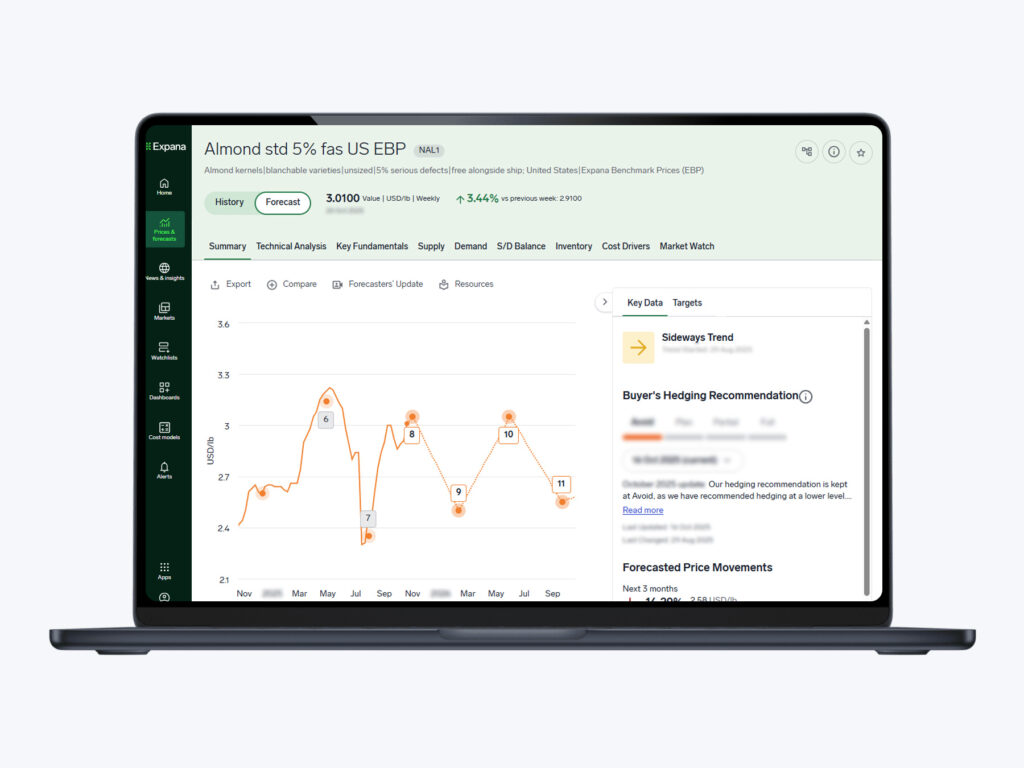
Real-time trend change notification, showing when a potential directional shift is identified.
Expana’s commodity price forecasts draw on market fundamentals, pricing models, and expert interpretation across almost 1,500 agrifood commodities – giving procurement teams the forward-looking context to inform decisions, strengthen internal conversations, and anticipate market shifts.
See how Expana forecasts work here.
* This commentary is prepared by Expana and its group of companies, neither of which is an investment firm. We have no positions in the commodities or derivatives referenced. The views expressed are for information only. See our disclaimer for more information: https://www.expanamarkets.com/disclaimer/
Written by Said Sahardeed