Key Takeaways
- The real question isn’t “what happened” — it’s “what did we know, and when?” Without a forecast trail, you can’t prove a decision was rational at the time.
- Forecasts today overwrite yesterday’s. The trail disappears, and with it, your ability to defend a call after the market moves.
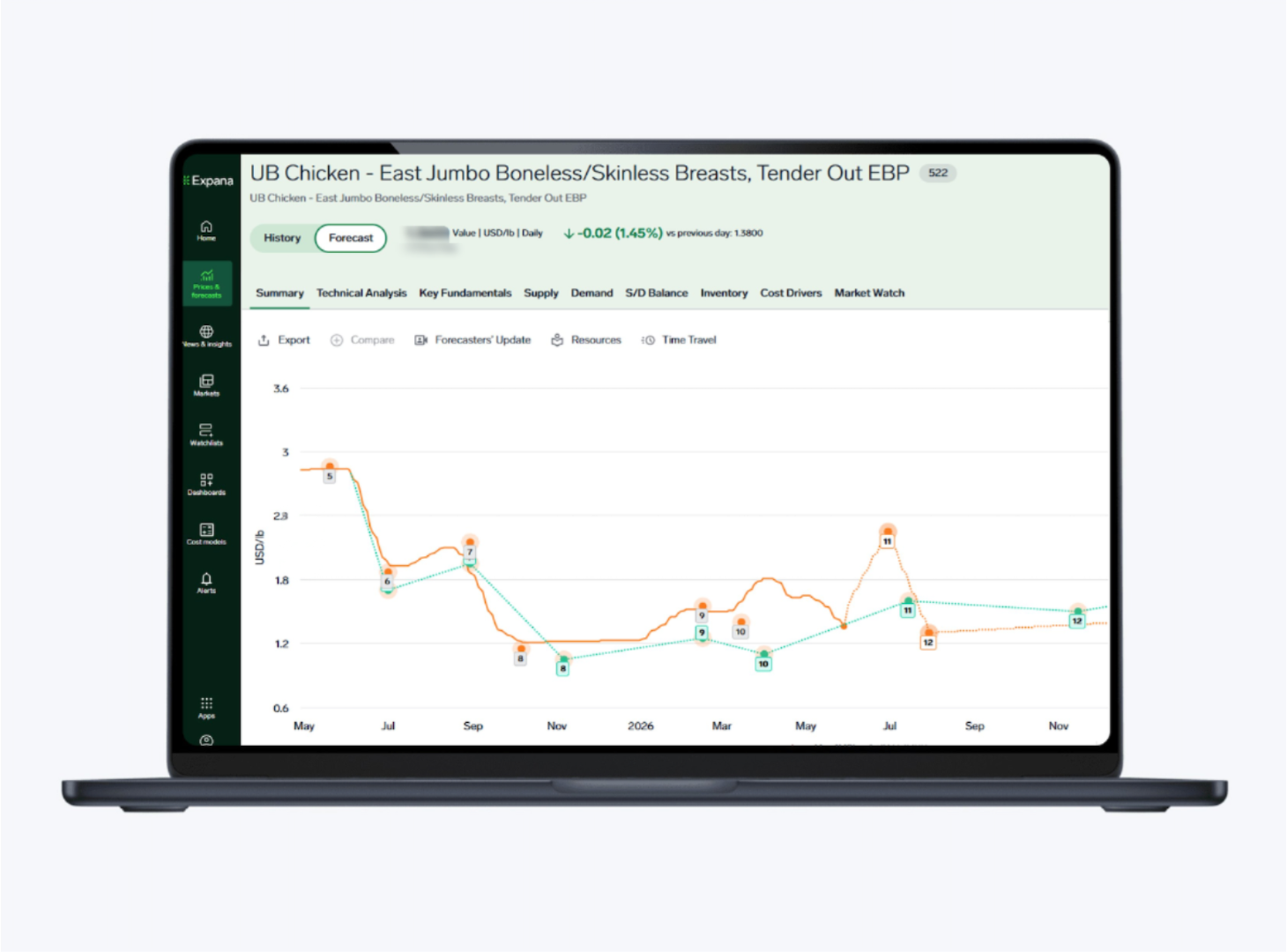
- Expana’s new Historical forecast transparency fixes this — revisit past forecast revisions overlaid on the chart, each with original analyst commentary.
- Bonus: it enables back-testing — teams can spot patterns in forecast performance and build sharper, commodity-specific intuition over time.
- Live now on Core forecasts — available directly on any Core forecast chart for existing clients.
When a commodity price doesn’t go where you expected, the question that matters isn’t just “what happened?” – it’s “what did the most informed forecast available at the time say was going to happen, and when did that change?”
A procurement director walks into a board meeting. Chicken is up 40% against budget. The CFO wants to know why it wasn’t anticipated. The honest answer is that six months ago, the forecast pointed the other way and then supply conditions shifted. The decision may well have been the right one based on what was known at the time. But without a historical forecast, that’s impossible to prove. The current forecast overwrites the last one. The trail disappears.
This isn’t just a forecasting problem. It’s a communication problem. Without visibility into how a forecast evolved, you can’t tell whether a market shift was visible early or came out of nowhere. And with it goes something valuable: the ability to show that a decision was rational at the time it was made, using the best available information.
We hear this problem consistently from clients. In their words:
“Forecasts change and there is no ability to see what has changed, or why the changes were made – this would help us understand market dynamics better.”
“I need to compare decisions made on the past view vs the new view, so we can see why the forecast has changed.”
“Target moves, there is no justification and currently I need to take a screenshot just to track the change in forecasts over time.”
Historical forecast transparency
To address this, Expana are excited to introduce Historical forecast transparency. This functionality allows users to revisit historical forecast revisions and overlay them directly on the chart showing how predictions for any commodity evolved over time. Each revision is accompanied by original analyst commentary, providing critical context behind the numbers.
The point isn’t just to show where a forecast landed. It’s to show the journey – each revision, what changed, and what was known at that moment.
For a procurement director presenting to the board, this changes the conversation entirely. Instead of explaining what happened, you can show what the market view looked like when a decision was made and identify when and why conditions changed. That’s the difference between “we got it wrong” and “here’s exactly what the market was pricing in when we committed, and here’s the revision where the picture shifted.”
For a VP fielding internal pressure, historical revision becomes powerful supporting context. If beef lands 30% above the buy, the chart shows the forecast path, when it shifted, and whether the outcome was within expected bounds. Historical forecast transparency links that variance to substantiated commentary, clearly explaining the drivers behind the move.
Here's what that looks like in practice:
Consider Brent crude as a live example. In February 2026, the Expana forecast pointed to a potential Q1 peak of roughly $76/bbl – a potential upward trend. This is the kind of market context teams can weigh when shaping their own hedging approach for the year.
By the end of March the price reached $118.35/bbl, driven by escalating geopolitical tensions across the Middle East. This isn’t a case of the forecast being “wrong.” It captured the direction the market took, based on the information available at the time, and informed a decision teams could stand behind. The only variable that changed was the scale of the move.
Historical forecast transparency makes that visible. By overlaying the February & March revision with current forecast, you can clearly see:
- when the market began to diverge from expectations
- how external events amplified the trend
A team that can walk into a discussion with that view isn’t explaining a miss. They’re demonstrating that they acted early on a well-founded market view, even as the market evolved beyond it.
- For traders and commercial teams, forecast revision history strengthens external credibility. Being able to show a documented history of how forecasts evolved and how closely they tracked what actually happened – builds trust and transparency.
There’s a broader benefit. Procurement teams that track forecast revisions alongside actual outcomes develop a clearer understanding of how market conditions and volatility influence signals over time. This helps build stronger, commodity specific intuition.
It also enables practical back-testing. Teams can review how past forecasts performed, identify patterns in market shifts, and understand which market conditions shaped forecast performance.
The real value lies in the revision process itself: what changed, when, and why.
Over time, this builds institutional knowledge that compounds – helping organisations make better, more confident decisions across budget cycles, particularly in volatile markets.
Historical forecast transparency is live now for Core forecasts. If you’re an existing Expana client, you’ll find it by selecting the Historical forecast transparency option on any Core forecast chart. If you’re not yet using Expana forecasting and want to see how this works across the commodities that matter to your business, request a demo.
This commentary is prepared by Expana and its group of companies, neither of which is an investment firm. We have no positions in the commodities or derivatives referenced. The views expressed are for information only. See our disclaimer for more information: https://www.expanamarkets.com/disclaimer/
Written by Expana