
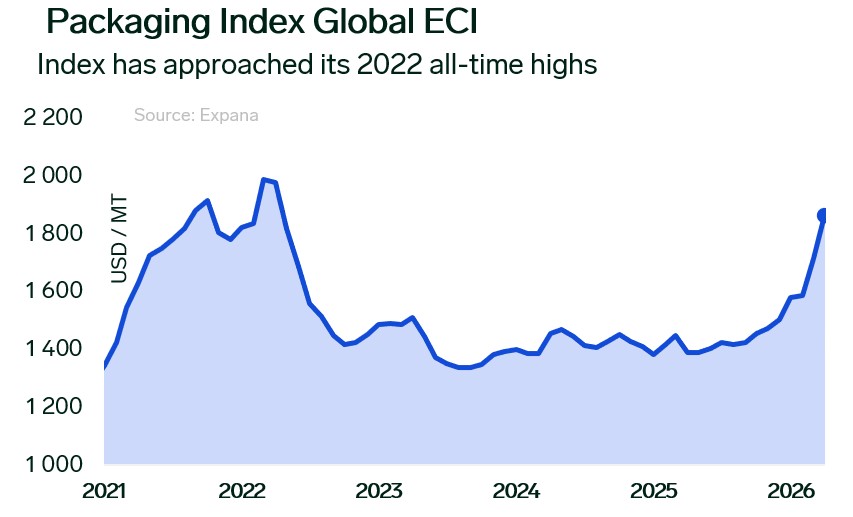
Packaging materials price increases in April 2026 are primarily driven by factors originating outside the packaging market. The main driver has been rising prices for various raw materials, which were influenced by global energy trends and geopolitical developments. Additionally, inflationary pressures resulted in increased costs throughout the production chain.
On the London Metal Exchange (LME), aluminum prices rose 6% month over month (MOM) and 47% year over year (YOY). This was caused by military activity in the Middle East, which led to a collapse in aluminum supplies from the region, creating a market deficit from March onward. Rising primary aluminum prices directly impacted aluminum packaging prices. In the US, aluminum foil increased 2.9% MOM, while aluminum cans rose 4.4% MOM. In Europe, aluminum foil climbed 2.7% MOM, with aluminum cans up 2.6% MOM.
Plastic packaging materials experienced even more significant growth, though this varied considerably between markets. In Europe, polypropylene (PP) prices rose 43.4% MOM, high-density polyethylene (HDPE) increased 39.2% MOM, and polyethylene terephthalate (PET) climbed 33.7% MOM. On the US market, growth was more modest but still substantial, with prices rising 6-7% MOM depending on the type. This regional contrast reflects the significantly higher dependence of European plastic production on naphtha and ethylene supplied through the Strait of Hormuz. The de facto closure of the Strait of Hormuz resulting from Middle East conflict triggered sharp price increases for these hydrocarbons in Europe.
For paper packaging production in Europe, the key driver was accumulated pulp price increases from the start of 2026 and waste paper prices rising 15-30% in April depending on grade. As a result, consumers anticipating further price increases stepped up purchases, and suppliers rapidly raised prices 3-5% MOM depending on grade, taking advantage of the situation. In the US, suppliers also implemented price increases after a prolonged pause. Linerboard rose 4.6% MOM, while testliner climbed 5.4% MOM.
Nevertheless, packaging materials consumption remains relatively weak, only partially explaining such significant price increases. Weakness is particularly evident in the beverage industry. In the Eurozone, soft drink and bottled water production in the first quarter of 2026 declined 0.2% YOY, while alcoholic beverage production fell 3-5%. In the US, soft drink production remains 0.9% below year-ago levels. Only in China did soft drink production grow 2% in the first quarter, with beer production up 4.2%.
Food production demonstrates more positive dynamics. In the Eurozone, it accelerated to 0.8% YOY for the first quarter, supported by 1.7% growth in March. In the US, food production grew 0.5% in the first quarter, representing a slowdown compared with 2025, when growth was 1.4%.
Retail sales present a mixed picture. In the US, retail sales accelerated to 4.0% YOY in March, supported by higher fuel prices and tax refunds, although real consumption growth remained significantly weaker due to inflation. In the Eurozone, retail sales slowed to 1.7% YOY in February from 2.1% in January, reflecting weakened consumer sentiment. In China, retail sales decelerated to 1.7% YOY in March from 2.8% in January-February, indicating softer consumption trends.
Thus, weak consumption in most regions does not align with the magnitude of packaging price increases. This confirms that the primary factor driving price dynamics is global raw materials and energy prices, not domestic demand for packaging materials.
Written by Artem Segen