The National Oceanic and Atmospheric Administration (NOAA) El Niño–Southern Oscillation (ENSO) Alert System has been elevated to El Niño Watch since mid-March. This signals an increased likelihood that El Niño conditions could develop in the coming months and have major implications for agriculture in 2026 and 2027. The current forecasts are still being made within the “spring predictability barrier,” a period when ENSO forecasts are inherently less reliable. Despite this uncertainty, risk assessment remains essential.
Key oceanic and atmospheric indicators are beginning to align in a way that warrants close monitoring. Historically, El Niño events can have wide‑ranging impacts on global weather patterns, commodity markets, and supply chains, making early awareness critical for planning and risk management.
What El Niño Means for Weather Around the Globe
El Niño years deliver certain weather patterns that influence global temperature and rainfall levels. These atmospheric shifts can increase the chance of droughts, floods, and heatwaves across multiple regions worldwide. Because agriculture depends heavily on consistent weather conditions, these disruptions can reverberate through food production systems, affecting crop yields, supply availability, and export markets.
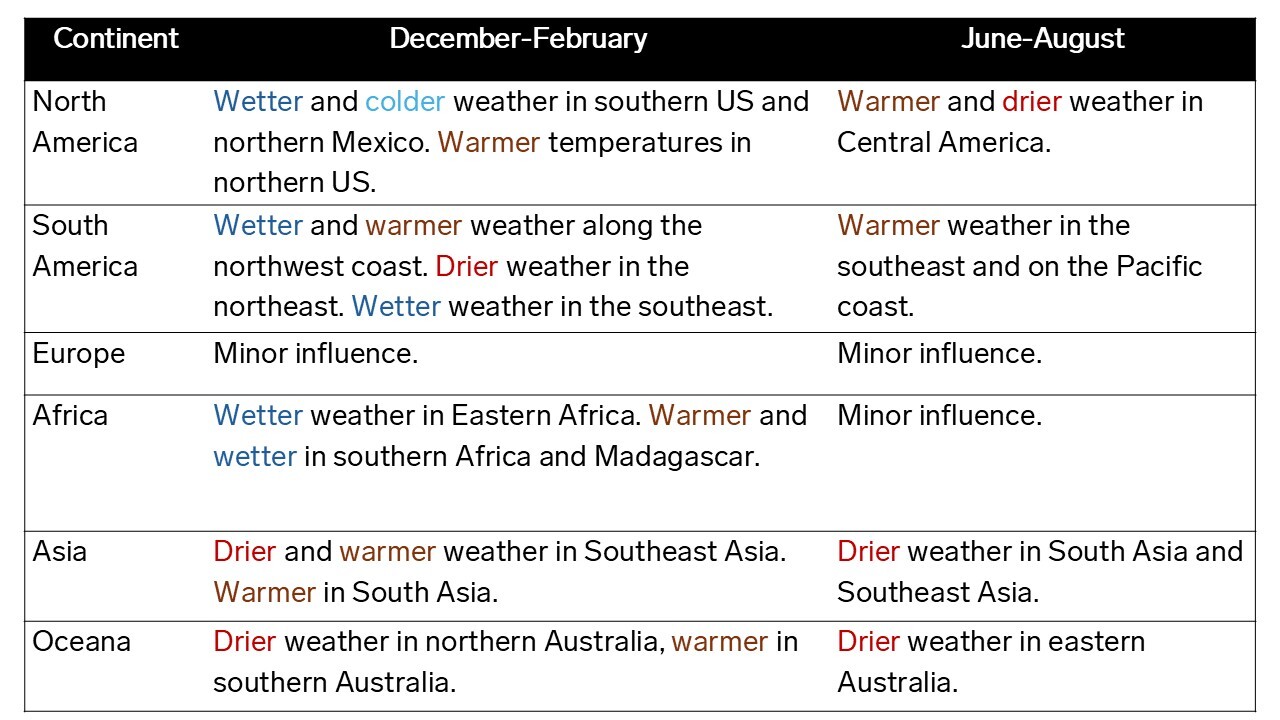
Table 1. Typical weather patterns caused by El Niño events, including affected crops, in December-February and June-August, based on a map by NOAA Climate.gov: https://www.climate.gov/news-features/featured-images/global-impacts-el-ni%C3%B1o-and-la-ni%C3%B1a. Note: El Niños can still influence weather beyond these months.
Rainfall
Although El Niño influences rainfall patterns around the globe, the changes in rainfall are often delayed or seasonally dependent, varying by region.
For example, in the United States, the increased rainfall associated with El Niño should be strongest toward the end of 2026 and early 2027. This can reduce the chance of drought and potentially support US grains, although it will depend on the timing and rainfall intensity.
In contrast, the lag between an El Niño event and altered weather patterns is usually shorter along South America’s Pacific coast and in Southeast Asia, where rainfall levels can be affected within weeks. The increased chances of drought in Southeast Asia could threaten crop production in 2026 and 2027, most notably for rice and palm oil. For India, the El Niño could reduce rainfall during the latter months of the 2026 monsoon season. The Indian Meteorological Department (IMD) currently forecasts the 2026 monsoon to have below-average rainfall, and El Niño could contribute. This may significantly impact kharif crops, such as rice, sugar cane, cotton, and peanuts, along with irrigated rabi crops such as wheat, oilseeds, and vegetables.
Temperatures
El Niño is associated with an increase in global temperatures, which is often delayed by several months in many regions. While temperature effects may begin to emerge in late 2026, El Niño is more likely to contribute to notably higher global temperatures in 2027. Combined with ongoing global warming, this increases the likelihood that 2027 could become the hottest year on record, placing additional pressure on agricultural systems — similar to how the 2023/24 El Niño contributed to 2024 being the warmest year on record. Above-conditions persist into late 2026 and 2027, prolonged stress on crops is likely.
Tropical Storms
El Niño typically increases storm activity in the eastern Pacific basin. This raises the risk of disruption to major commodities in Central America, including tropical fruits, citrus, and vegetables. Mexico is a major exporter of various products, so supply disruptions can affect markets in key export destinations, such as the US.
Additionally, while tropical storm impacts in California are rare, El Niño increases their likelihood. In contrast, El Niño typically suppresses storm activity in the Atlantic Ocean, lowering the risk of hurricanes affecting the US Southeast. As a result, crops commonly impacted by hurricanes in the US, such as citrus, sugar cane, cotton, grains, and nuts, are generally at lower risk from tropical storms.
Transport
Drought related disruptions can also affect transportation corridors within global supply chains. The Panama Canal, which depends on freshwater to operate, demonstrates this vulnerability. Droughts triggered by El Niño in 1997/98, 2015/16, and 2023/24 have disrupted global shipping by causing shipping restrictions, vessel delays, and higher transportation costs.
Despite the upcoming El Niño, the Panama Canal Authority has recently announced it is not planning restrictions for 2026, but the threat of drought-induced disruption in 2027 remains. Elsewhere, reduced rainfall could lower water levels in major rivers used for cargo transport. This occurred in 2023/24, when the El Niño contributed to low water levels and shipping disruptions along the Amazon River.
An El Niño is forecasted, but at what strength?
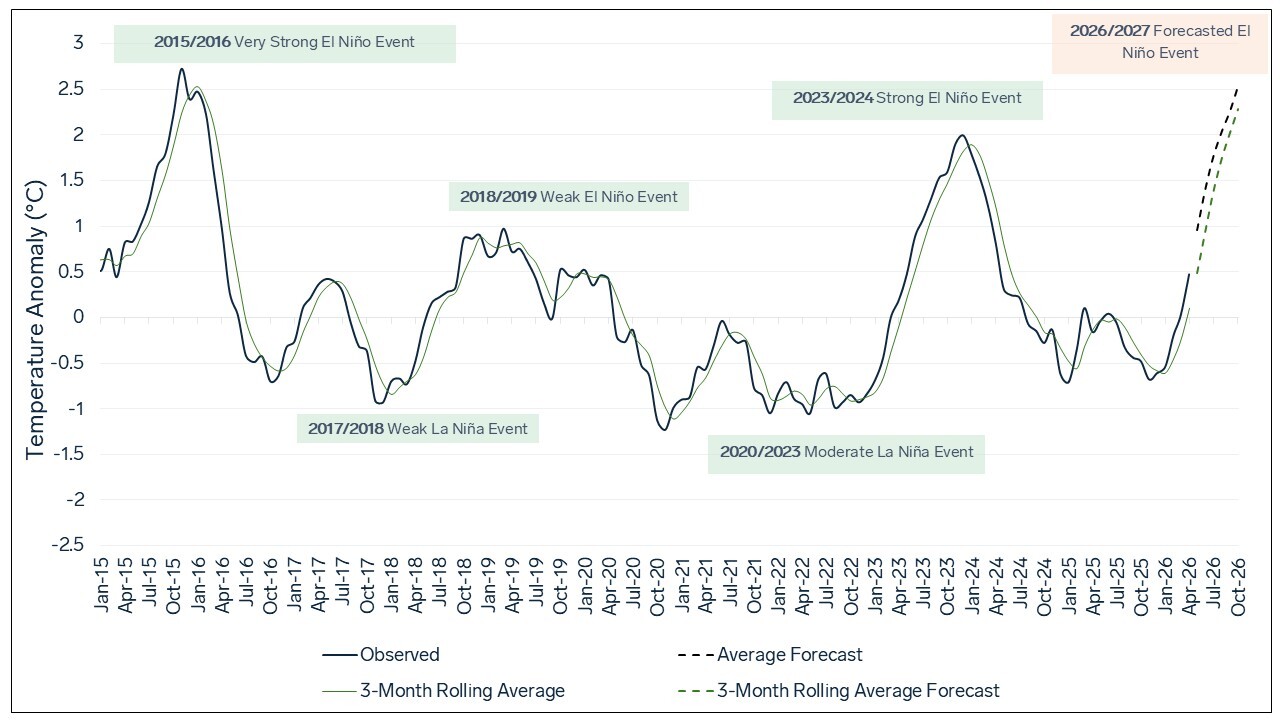
Figure 1. Niño 3.4 region Sea Surface Temperature anomaly since Jan 2015, using NOAA CPC monthly OISST dataset (0R08). A 3-month rolling average is provided in line with the Oceanic Niño Index (ONI). The average forecast is provided based on the following forecasting centers: NOAA-NCEP, ECMWF, Met Office, Meteo France, DWD, JMA, CMCC, and CANSIPS.
Tracking and forecasting the El Niño–Southern Oscillation (ENSO) is most commonly done using seeratures (SSTs) difference from the historical average in the Niño 3.4 region, located in the central Pacific Ocean. Based on the traditional Oceanic Niño Index (ONI), El Niño conditions are defined when the three‑month rolling average of SST anomalies in the 3.4 region exceeds +0.5 °C. In line with the ONI method, the average forecast from multiple centers around the globe (Figure 1) indicates the SSTs will start crossing the El Niño threshold as soon as June.
One important question that remains: What is the “strength” of the El Niño event? The stronger El Niño, the more likely it is that the extreme weather patterns typically associated with such events will materialize The given forecast indicates this El Niño event may become “very strong,” also sometimes referred to as a “super El Niño,” by September, as the rolling average could exceed +2°C. This would make it stronger than the last El Niño in 2023/24, and similar in strength to the 2015/16 El Niño.
Forecasts at this stage come with natural limitations. While predicting sea surface temperatures months ahead is always complex, ENSO forecasts made in March, April, and May tend to be less precise due to the “spring predictability barrier,” a seasonal window when ocean-atmosphere interactions temporarily weaken. As these systems begin to reinforce each other from June onward, ENSO forecasts typically gain more reliability.
Regardless of its strength, an El Niño event is highly likely to develop soon, with broad agreement across major forecasting centers and the more reliable short‑term forecasts indicating its arrival. While clarity around intensity is likely to improve as forecasts move beyond the spring predictability barrier in June, El Niño is expected to begin influencing global weather patterns by late 2026.
For procurement and supply‑chain leaders, this creates an early opportunity to act. Monitoring El Niño’s evolution now can inform sourcing decisions, stress‑test supplier exposure, and help mitigate weather‑driven disruptions before they impact costs, availability, and margins.
Leveraging Expana’s comprehensive database of commodity prices and market insights is critical to planning for and responding to potential supply disruptions caused by the upcoming El Niño – Request a demo here.
Written by James Tyler